Homeschooling Through the Holidays Without Losing It

The workable homeschool December schedule is a short, honest one: drop to a minimum school day — math and reading, thirty to sixty minutes, four days a week — for the first two weeks of the month, then stop entirely for a real break of at least two weeks. Don’t try to run a normal term through a season that is already a full-time job. Decide the shape of it in October while you can still think, bank the buffer weeks that make it possible, and write the January restart date down before you close the books. December doesn’t need a special curriculum. It needs a smaller one.
This domain’s archive had a post called “Staying sane homeschooling during the holidays,” which tells you the problem is at least fifteen years old and probably closer to fifty. I grew up in a homeschool that quietly abandoned its schedule every December and made it up in July, and I now run the same trick with better paperwork. Here’s the operations version.
Decide the shape in October
Every December disaster I’ve watched started as an unmade decision. The family kept “planning to keep going,” never picked a stop date, and spent four weeks doing school badly while feeling guilty about doing it at all. That’s the worst of both: no learning and no rest.
So choose one of three shapes, in October, and write it on the year plan:
- Light-and-stop. Two weeks of a minimum day, then two to three weeks fully off. The default, and what most families end up doing whether they planned to or not.
- Stop early, start early. Take the whole of December off and restart the first full week of January. Works beautifully if you school year-round and have the weeks banked elsewhere.
- Run through, keep the break short. Full days until the week of the holiday, one week off. Only sane if your household’s celebrations are genuinely low-effort, and I’d argue nobody’s are.
The choice matters less than the fact that it’s a choice. A written stop date turns “should we be doing school today?” — asked daily, resentfully, by everyone — into a settled matter.
The minimum school day
The concept that saves December is a minimum day: the smallest amount of school that still counts as school, defined in advance so you can run it on the worst day of the month without negotiating.
Ours is three things:
- Math. One lesson, or the review page if the lesson is a bad idea today. Math is the subject that punishes gaps hardest, which is exactly why it stays.
- Reading. Twenty minutes of the child’s own book, or a read-aloud if everyone’s frayed.
- One page of anything else. Handwriting, a copywork line, a science reading. Nothing that needs prep from me.
That’s it. Forty minutes, done by nine-thirty, and the rest of the day belongs to the season. What makes a minimum day work is that it is pre-approved — you’re not cutting corners, you’re running the plan. Nobody has to decide whether today counts.
Two rules keep it honest. Do the minimum day first, before errands and baking, because December afternoons evaporate. And don’t let it quietly become the normal day in February — it has a start and end date for a reason.
December is a teaching month, but not on paper
The season does teach, and you don’t need to organize it into a unit study to get the benefit. Baking is fractions and sequencing. A gift budget divided among four cousins is division with a real consequence. Wrapping is geometry and estimation. Cards are handwriting practice with an actual audience, which is the only kind a seven-year-old respects. Travel is maps, elapsed time, and money. The framework is the everyday-math one: the house is the practice, the lesson is the instruction, and in December the house does most of the lifting.
What I’d avoid is the trap of converting all this into a documented curriculum — printable advent packets, a themed unit for every day. That’s a second holiday to run, and it’s usually the thing that makes a December homeschool collapse. Let the season teach informally. Note what happened in your log afterward if your record-keeping needs it, rather than planning it forward.
Two additions that cost nothing: a holiday read-aloud basket — a stack of seasonal picture books and one longer chapter book, pulled from the library in November, read after dinner instead of scheduled at a lesson time — and a standing rule that the audiobook goes on for wrapping, baking, and the drive. Both run themselves.
What the record-keeping actually requires
Here’s where I stop and signpost, because this is the part people get wrong under time pressure. Some states expect a certain number of instruction days or hours, some expect attendance records, some expect nothing at all, and the rules change. Your December plan has to fit whatever your state actually requires — so check it at the source rather than taking a blogger’s word for it, using the two-source method in how to find your state’s homeschool rules. If you do count hours, decide in advance how you’re logging the informal December learning, and log it the same way every year.
The practical planning move is simpler: put December’s reduced weeks into the year plan as reduced weeks, so the total still lands where you need it. That’s the whole reason year planning blocks the calendar before it schedules subjects.
Buffer weeks are what make the break possible
A family that can take three weeks off in December is almost always a family that built slack into the autumn. The mechanism is boring and it works: schedule four to six unassigned weeks across the year, and don’t spend them in September. By late November you’ll know exactly how many you have left, and that number tells you what December can be.
If you arrive at December with no slack and a schedule already behind, take the break anyway. A tired parent grinding through a holiday season is the standard on-ramp to a January collapse — that’s the whole argument in homeschool burnout, and December is when the crash gets booked.
Coming back in January
Set the restart date before you stop, and make the first day back deliberately easy: minimum day only, no new material, nothing you have to teach cold. Add a second day of the same. Full days from the third day on.
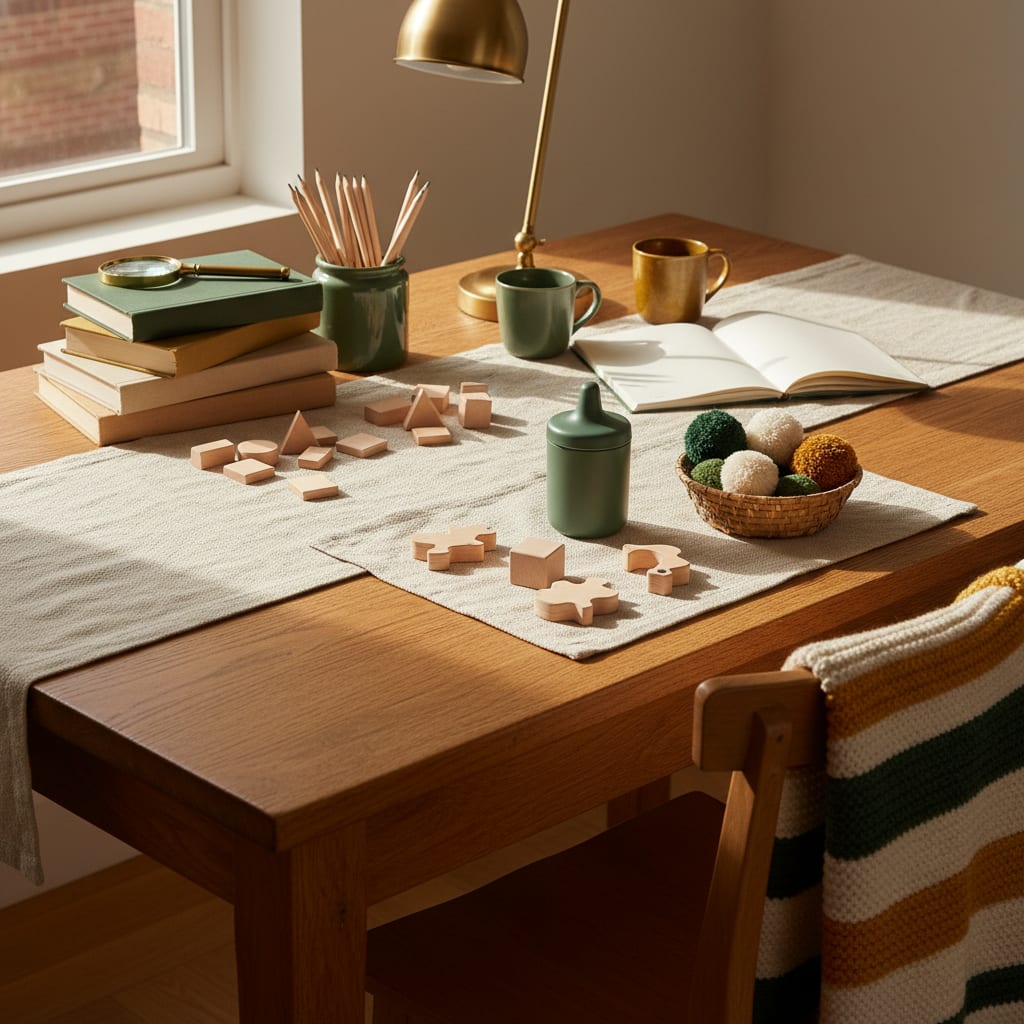
Two small things make the restart painless. Leave the table ready in December — books stacked for day one, pencils sharpened, the first week’s pages marked — because January-you will not want to plan anything. And expect the first week to be slow, not because anyone forgot how to read but because everyone forgot how to sit down. Three days and the rhythm is back.
FAQ: homeschooling in December
Most families do best with a shortened month rather than a full stop or a full term: a minimum school day for the first half of December, then a genuine break of two to three weeks. The academic cost of a lighter month is close to zero; the cost of a burned-out parent in January is not.
How many weeks off should we take?
Two to three is typical, and it only works if the weeks were budgeted earlier in the year. Families schooling year-round often take longer, because they’ve already banked the time elsewhere in the calendar.
My kids are behind. Can we skip the break?
Working through the holidays is the least productive catch-up you will ever attempt — the days are interrupted, everyone’s overstimulated, and the material won’t stick. Take the break and reclaim the time with a longer January term or an added summer block. Consistent short days beat one heroic month, always.
How do we keep the routine from disappearing entirely?
Anchor the minimum day to something that happens anyway — after breakfast, before anyone leaves the house — and keep it in the same place at the table. Habit survives on location and sequence far better than it survives on intention.
What about co-op and outside classes in December?
Most groups pause; the ones that don’t often run a party rather than a lesson. Decide early whether you’re attending, and treat a December co-op day as the whole school day rather than an addition to it.