Charlotte Mason Homeschooling: What a Day Actually Looks Like
Charlotte Mason homeschooling is a method built on the ideas of a 19th-century British educator. Its school day uses short lessons, about 10 to 20 minutes per subject for young children, taught from “living books” written by authors who know and love their subject, instead of textbooks. Children show what they’ve learned by narrating, which means telling it back in their own words, rather than filling in comprehension worksheets. Copywork and dictation handle spelling and handwriting, nature study and plenty of outdoor time cover early science, and art, music and poetry come every week. Formal lessons are usually finished by lunch.
It makes more sense once you see the hours of a day.
Who Charlotte Mason was, briefly
AmblesideOnline’s introduction to Charlotte Mason describes her as an educator who “lived in England in the 1800’s” and who believed children were “already real people capable of independent, intelligent thought” who “needed vital ideas, rather than dry facts.” Her pupils, it says, read living books, “took daily nature walks and recorded their observations in notebooks,” studied art and music, and “by using short lessons, they accomplished all of this (and more) by lunchtime.” She summed education up as “an atmosphere, a discipline, and a life.”
Her approach faded during the 20th century. The same page credits Susan Schaeffer Macaulay’s 1987 book For the Children’s Sake with bringing it back to a new generation of homeschoolers. Mason’s own six volumes are still in print, starting with Home Education, and AmblesideOnline also hosts them free online.
The core practices
Short lessons. Ten to twenty minutes per subject for younger children, longer for older ones, with “an emphasis on excellent execution and focused attention.” The idea is that a child gives full attention for a short time rather than half-attention for a long one, and that the day varies so no single task wears them out.
Living books. AmblesideOnline defines a living book as having “the best material, from the best minds, or at least the real story from someone who was there or has a real interest in their subject,” with quality “preferred over quantity.” History comes from well-written narratives, biographies and source documents read in order. Schoolbooks are read slowly, a few pages at a time.
Narration. After a reading, the child tells it back: aloud at first, in writing later. In Mason’s method this replaces both the comprehension questions and, in the early years, composition. It looks easy and isn’t. How narration grows into written work is covered in teaching writing at home, alongside copywork and dictation.
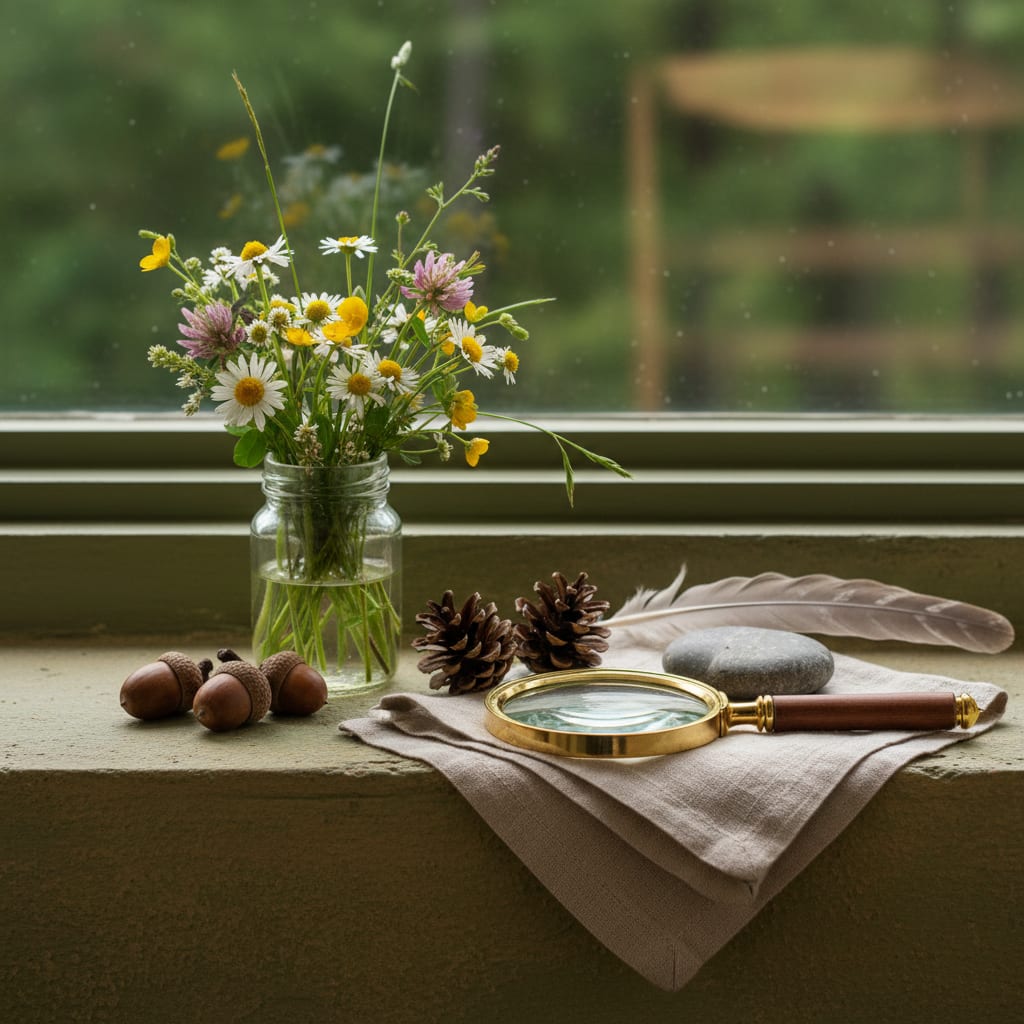
Nature study and outdoor time. Regular walks, close observation and a nature notebook. AmblesideOnline notes that for children under six, school “consisted almost entirely of time spent outdoors.”
Habit training. Building habits such as attention to detail, focused attention and consideration for others on purpose, one at a time. Mason didn’t use gold stars or prizes, and she discouraged competition.
A wide “feast.” Picture study (looking closely at one painting, then describing it from memory), composer study, poetry, folk songs, a foreign language, handicrafts and, for older children, Shakespeare and Plutarch.
What a Charlotte Mason day looks like
Here’s the shape of a Charlotte Mason-style morning for an eight-year-old and a six-year-old. We borrow from this method more than from any other. Treat it as an example, not a schedule to copy.
| Time | Lesson | Length |
|---|---|---|
| 9:00 | Together time: a poem, a folk song, a few minutes of picture study | 15 min |
| 9:15 | Math, each child at their own level | 20 min |
| 9:35 | Copywork: one or two sentences, written carefully | 10 min |
| 9:45 | History reading from a living book, then oral narration | 20 min |
| 10:05 | Outside: snack and a run | 20 min |
| 10:25 | Reading lesson (younger) / independent reading (older) | 15 min |
| 10:40 | Natural history reading, then narration or a drawing | 15 min |
| 10:55 | Handicraft or drawing | 20 min |
| Afternoon | Nature walk, free play, the children’s own projects | — |
A few things stand out once you live it:
- No lesson runs long. When the time is up, the book closes, even mid-chapter. One longtime AmblesideOnline parent quoted on its intro page says her children are “fresher and stay interested longer with short lessons.”
- The subjects alternate. Reading, then writing, then something with the hands, then outside. AmblesideOnline describes this “variation in the day’s scheduled activities” as a deliberate way to avoid tiring one kind of attention.
- Narration is how you check. There’s very little written busywork, so narration is where you find out what went in.
- The together time does a lot. Poetry, music and art fit in the first fifteen minutes. That block is essentially a morning basket, which is why that post gets asked whether it’s a Charlotte Mason idea.
Math is the subject where many Charlotte Mason families use a separate, ordinary program. AmblesideOnline says Mason emphasized reasoning over “working sums,” which makes “a manipulative-based instruction” desirable.
Faith and Charlotte Mason
Mason was a Christian, and her philosophy is grounded in that faith. AmblesideOnline, the best-known free Charlotte Mason curriculum, says so plainly: it describes “the knowledge of God, as found in the Bible” as “the primary knowledge and the most important,” and its curriculum aims to prepare children for “rich relationships with everything around them: God, humanity, and the natural world.” Many Charlotte Mason programs are faith-based for the same reason.
Secular adaptations exist too, keeping the methods (short lessons, living books, narration, nature study) and leaving out the religious content. Programs such as Blossom & Root and Build Your Library are covered on our secular homeschool curriculum page. Choose the version that fits your family. Narration and nature walks work the same either way.
AmblesideOnline: the free way in
AmblesideOnline calls itself “a free homeschool curriculum that uses Charlotte Mason’s classically-based principles,” with “detailed schedules, time-tested methods, and extensive teacher resources.” It’s arranged by years rather than grades, from Year 0 through Year 12, and it hosts Mason’s original books and modern English paraphrases free online. It also offers a lighter emergency plan for families in a crisis.
The curriculum is free; the books aren’t, though many are public domain or at the library.
Who it suits, and who it frustrates
It tends to suit:
- families who love reading aloud and have a good library nearby;
- children who listen well and like stories;
- parents who are comfortable judging progress through conversation rather than test scores;
- mixed-age households, since history, nature study, art and music can be shared.
It tends to frustrate:
- parents who want clear marks, tests and finished workbook pages as proof of progress (assessment here is light by design, mostly through narration);
- children who find oral narration hard and have no other way to show what they know;
- families short of time to find and read so many books;
- anyone hoping for a boxed, open-and-go plan, since most Charlotte Mason homeschooling is assembled rather than bought.
Record and testing requirements vary by state, so check what applies to you. Narration notes and a running reading list make a good record whatever method you use.
How it differs from other methods
AmblesideOnline is clear that Charlotte Mason isn’t unschooling: lessons are teacher-directed and planned, while the child’s own interests fill the free afternoons. It isn’t unit studies either, since Mason preferred children to make connections across subjects themselves rather than having lessons arranged around a theme. It overlaps with classical education, especially in the later years, but doesn’t use the trivium’s stages. Montessori is a separate method with different foundations, explained at Montessori Bloggers Network. For the bigger picture of choosing among methods, start with how to choose homeschool curriculum.
FAQ: Charlotte Mason homeschooling
Is Charlotte Mason homeschooling religious?
Mason’s own philosophy is Christian, and many Charlotte Mason curricula, including AmblesideOnline, are faith-based. Secular adaptations keep the methods without the religious content.
How long are Charlotte Mason lessons?
For younger children, roughly 10 to 20 minutes per subject, getting longer as children grow. Formal lessons usually finish by lunchtime.
What is a living book?
A book written by an author with real knowledge of and interest in the subject, usually in a narrative style, as opposed to a textbook summary. It can be fiction or nonfiction.
Does Charlotte Mason work for high school?
It can. AmblesideOnline’s plan runs through Year 12. The reading load gets heavy, and many families add outside courses for upper math and lab science.