Morning Basket: How We Start Every School Day
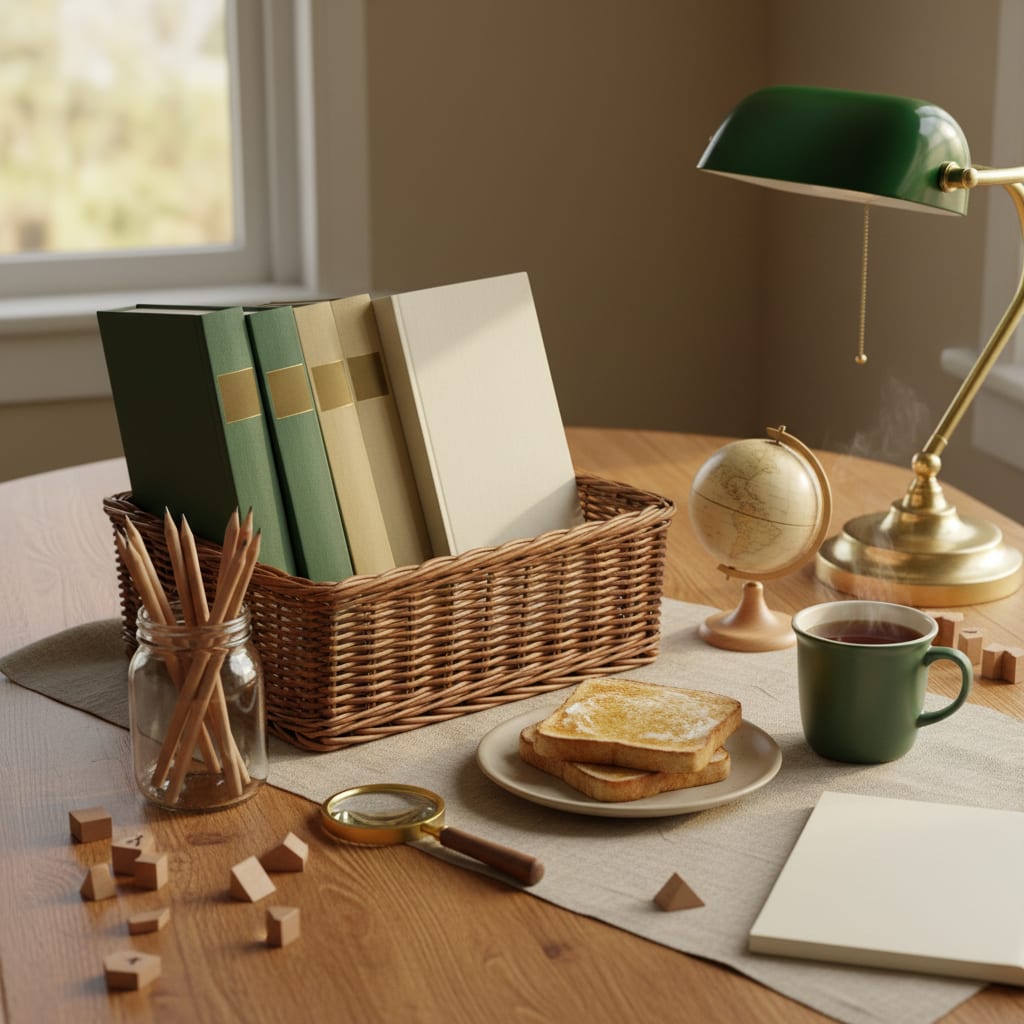
A morning basket is a literal basket of things you read and do together at the start of the day — a read-aloud chapter, a poem, a map, memory work, maybe a hymn or a folk song or a picture to look at — done with every child present regardless of age. Ours runs about forty minutes and covers the subjects that would otherwise get squeezed out entirely. It is not a subject. It’s the start signal: I sit down, I open the book, and the day has begun without anyone announcing it.
That last part is why it survives in houses where nothing else does. The hardest twenty minutes of a homeschool day are the ones before it starts.
What a morning basket is
Physically, a basket, a crate or a shelf that holds five or six things and lives where you eat. Practically, a short daily block of together-work for mixed ages, done out loud.
The format is old and the name is newer than the practice — families have been reading aloud over breakfast for a very long time. What the container adds is that everything you need is in arm’s reach, which removes the four trips to other rooms that used to sink our mornings before I copied the idea from a co-op friend.
Why it beats a first period
Mixed ages work in it. My eight-year-old and my six-year-old cannot do the same math page. They can absolutely listen to the same chapter, look at the same map and learn the same poem, each taking what they take. Anything genuinely group-able belongs here — and the more you move into this block, the shorter the one-to-one part of your day gets.
It’s the subjects that get dropped. Poetry, geography, art, composers, memory work, natural history: individually skippable, collectively most of a liberal education. Putting them in the first forty minutes means they happen before the day can go wrong.
It runs on toast. Ours starts while breakfast is being finished, which converts dead time into the most content-dense part of our morning.
It’s a ritual, not a rule. A start ritual does what a bell does in a school building. This is the first of the three pins the rest of our homeschool schedule hangs on, and it’s the one I’d keep if I could only keep one.
What goes in ours right now
Six things, and only six — a basket you can’t lift is a basket you’ll stop using.
- A read-aloud chapter book, one chapter a day. Currently something well above my six-year-old’s reading level, which is the point: listening comprehension runs years ahead of decoding.
- A poetry anthology. One poem, read twice, no analysis. We use a fat general anthology rather than a curriculum — The Random House Book of Poetry for Children has been in this house since my own childhood and is the one I’d buy again.
- A map or globe, such as the Replogle Student classic world globe. Whatever place the read-aloud mentioned gets found. Thirty seconds. Over a year it’s a geography course.
- Memory work cards. A poem, a list, a passage — recited, not written. Four minutes.
- One art or music thing. A postcard-sized print propped against the fruit bowl for a fortnight, or one piece of music played while they eat. No worksheet, ever.
- A picture book, for the toddler’s benefit and everyone’s pleasure. The eight-year-old pretends not to listen.
Notice what isn’t in there: nothing that needs marking, nothing anyone can fail at, and nothing requiring a device. The block has to be low-friction or it dies.
How long it should last
Match it to the youngest child who has to sit through it, then stop before anyone asks you to.
- Ages 4–5: ten to fifteen minutes. One story, one poem, done.
- Ages 6–8: twenty-five to forty minutes, most of it read-aloud.
- Ages 9–12: forty-five minutes to an hour is sustainable, and this is where discussion starts pulling its weight.
The reliable failure is length. Basket time expands beautifully in January and by March you have a ninety-minute morning ritual and no time left to teach reading. If it’s crowding out the skill subjects, it’s too long, however lovely it is.
Keeping it alive past October
Every family I know starts a morning basket in August with real enthusiasm. Two-thirds have quietly stopped by Halloween. What separates the survivors:
Rotate, don’t add. When something goes stale, take it out. The basket has six slots; a new thing means an old thing leaves. Adding is how you get the ninety-minute problem.
Loop the extras. Art, composer, nature reading and geography don’t all need to happen daily — run them as a loop so each turns up every few days. That’s the whole mechanism described in loop scheduling, applied to one block.
Prep it once a term, not daily. Choose the read-aloud, the poems and the prints in one sitting when you plan the term, put them in the basket, and don’t decide anything at 8:30 in the morning. Half of that work is already done if you’ve done a term plan — see plan your homeschool year in one afternoon.
Let them do things with their hands. Drawing, knitting, LEGO, playdough. A child who is building listens better than a child who is being told to sit still, and the fight about sitting still is the thing that will eventually kill your basket.
Keep it when the day is a write-off. Sick, snowed in, everyone miserable: do the basket anyway and cancel everything else. Forty minutes preserves the shape of the week.
Morning basket with a toddler at the table
The two-year-old is why our basket is at the kitchen table rather than on a sofa. Contained seating, food within reach, and a bin of quiet toys kept only for this block — scarcity is what makes them interesting for the full forty minutes.
Realistically she participates for about ten minutes of it and then does her own thing near us, which is fine; the aim is that she’s present rather than engaged. Interruptions are handled by carrying on. If I stop the chapter every time a cup of milk goes over, the older two learn that noise ends school, which is a much more expensive lesson than a spilled drink. The broader system for teaching with a small person underfoot — the parallel activities, the rotation, the honest limits — is in homeschooling with a toddler underfoot.
And on the mornings the toddler is genuinely unmanageable, the basket moves to lunch. Same six things, three hours later. The block is portable; that’s a feature.
FAQ: morning baskets
A morning basket is a short daily block of together-work — read-aloud, poetry, memory work, map and art — done with all ages at once at the start of the day, typically ten to fifteen minutes for preschoolers and up to an hour by upper elementary.
What should go in a homeschool morning basket?
A read-aloud, a poetry anthology, memory work, a map or globe, and one art or music element. Five or six items total. Anything that needs marking, printing or a device belongs elsewhere in the day.
Is a morning basket only for Charlotte Mason homeschoolers?
No. The practice predates the label and works with any method — the format is simply group-able content read aloud. Families using boxed curricula, unit studies or a state-aligned program all run some version of it, sometimes under a different name.
What age should you start a morning basket?
As soon as the oldest child can sit for a short chapter, usually four or five, with the length set by the youngest participant. Starting small and stopping early is what builds the habit; a first basket that runs ten minutes is a success.
Do you have to do it in the morning?
No, though the name is stubborn. Families with early-shift parents, late risers or a badly timed nap run the same block at lunch or in the afternoon. What matters is that it’s the same slot daily and that it functions as the day’s start signal, whenever that start happens to be.