Homeschooling With a Toddler Underfoot
Homeschooling with a toddler underfoot works when you stop scheduling around subjects and start scheduling around the toddler: anchor the hardest lessons to the nap, give the toddler a real job at the table (special boxes that only appear at school time), rotate big kids between independent work and toddler duty, and accept that some subjects simply live in the afternoon quiet hour. The toddler isn’t the obstacle to the school day — the toddler is the schedule, and the sooner the plan admits that, the calmer everyone gets.
“What do our little ones do while we work with our big ones?” was a question on this site back in its 2011 archive, and it may be the most permanent question in home education. My mother solved it with five kids in the ’90s; I’m solving it now with an 8-year-old, a 6-year-old, and a 2-year-old who still naps — which, I’ll say up front, is the only reason phonics happens in our house. Here’s the system, from the youngest sibling who ever sat under that table to the mom now running it.
The nap is the master schedule
Write this at the top of the plan: the toddler’s nap is the most valuable academic hour of the day. Ours holds the read-aloud and my 6-year-old’s reading lesson — the two things that genuinely require my full attention and silence. Everything else (math pages, copywork, science-by-library-book) gets deliberately scheduled outside the nap, because those can survive a toddler orbiting the table. When people ask how many hours a day homeschooling takes, the honest sub-answer for the little-kids stage is: however many the nap and the quiet hour will fund.
The corollary: protecting that nap is protecting the school day. When our third started fighting her nap last winter — the classic almost-two chaos — the whole academic schedule went down with it, and I got systematic about her sleep for frankly selfish curricular reasons. We used Betteroo, a personalized sleep program: you answer a quiz about your kid and your parenting style, and it builds a day-by-day plan — today’s nap window, tonight’s bedtime — and keeps adjusting as she changes. Balanced verdict, because that’s house policy: it’s a tool, not magic — it costs around $20 a month, it won’t put the child to sleep for you, and a family with a settled napper doesn’t need it. But for us it turned “is the nap moving or is this a phase?” from a nightly debate into a plan, and the read-aloud block got its hour back. For the deeper theory of building a home day around naps, my colleague-in-arms at One Mom’s Guide has the definitive piece: build your day around naps.

Table-time boxes: the toddler gets a curriculum too
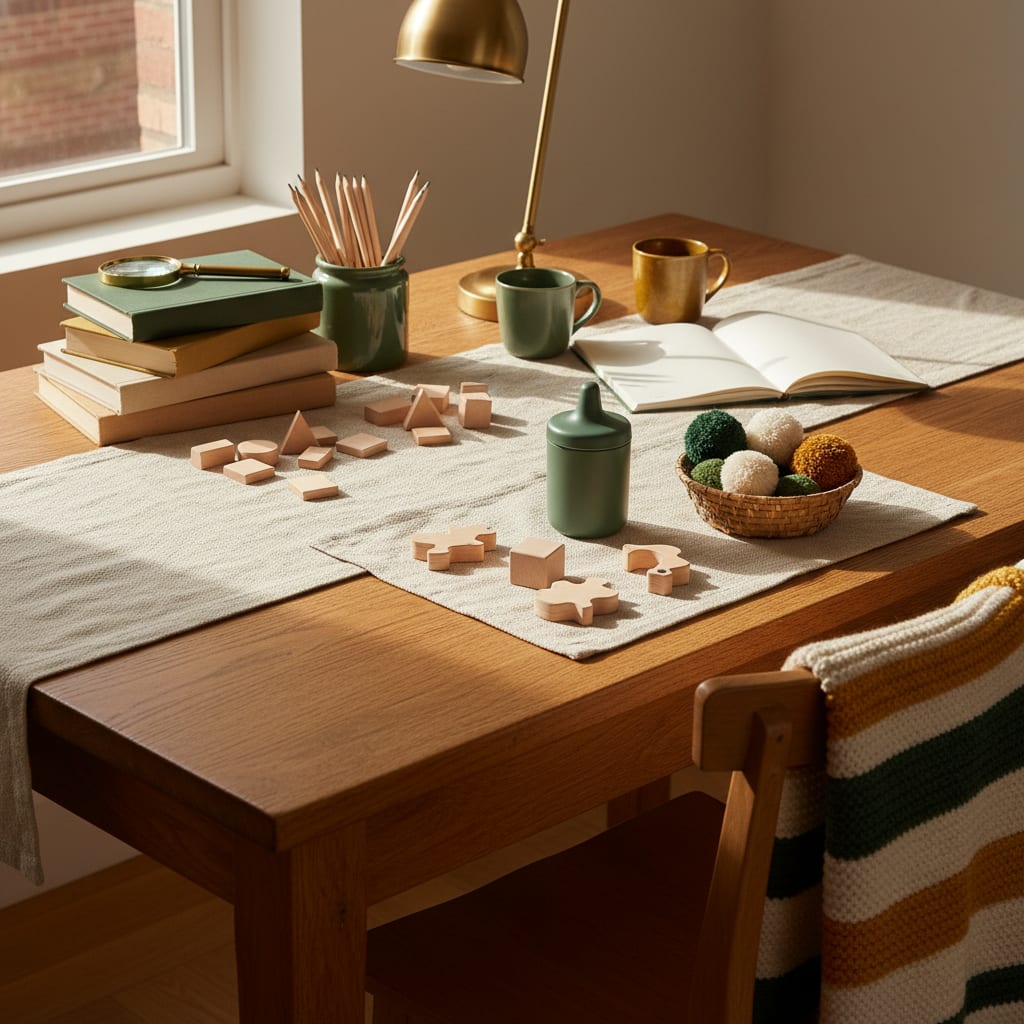
The second pillar is ancient co-op wisdom: special activities that only appear during school time. Ours is a shelf of shoebox-sized bins — chunky puzzles, a busy bag of jumbo pom-poms and tongs, sticker pages, and the reigning champion, a mess-free Water Wow pad (paint-with-water pages that dry blank and reset; ours have survived two children and a car). One bin per school block, rotated weekly so nothing goes stale. The scarcity is the entire technology: the moment the bins become all-day toys, they stop buying you twenty minutes of math.
Buddy blocks: the big kids are staff
With more than one student, run the day in rotating pairs: while I teach the 6-year-old, the 8-year-old is either on independent work or on toddler duty — block towers, “read” a picture book, supervised backyard laps. Fifteen-minute shifts, treated as a real responsibility, not a chore. Second-generation disclosure: I was the toddler in this system before I was the staff, and I can report from both roles that toddler duty made me feel important at eight and made me feel loved at two. It also, incidentally, is where a lot of the famous homeschool sibling-closeness actually gets manufactured.
Lower the bar on purpose, and put it in the plan
Some seasons, the toddler wins anyway — molars, a dropped nap, a virus lapping the family. The move is to shrink the school day on purpose before it shrinks by collapse: reading and math only, everything else through audiobooks and errands, for as many weeks as the season lasts. A planned minimum keeps you off the burnout cliff, and if you build that minimum into your year plan from the start — we schedule ours assuming six “survival weeks” a year — you’ll never have to invent it mid-crisis at 9pm.
FAQ: homeschooling with little ones
How do you homeschool with a toddler who won’t nap?
Shift attention-heavy lessons to a daily quiet hour (toddler in crib or room with safe activities), run short lesson blocks during table-time bins, and lean on afternoon or evening slots for the big kids. If the nap is dropping earlier than expected, a structured plan — a sleep program like Betteroo, or your pediatrician’s guidance — beats nightly guessing.
What can a toddler do during homeschool lessons?
School-time-only bins: puzzles, tongs-and-pom-pom bags, stickers, water-reveal pads, play dough at the same table. Rotate weekly, present one at a time, and retire anything that’s stopped working for a month — novelty is the active ingredient.
Can you homeschool with a baby and a toddler at once?
Yes — babywearing through the read-aloud, lessons during the baby’s morning nap, and a shorter formal day. Families have run bigger classrooms than yours off a kitchen table for generations; the curriculum flexes, the littles grow, and no one remembers the year math took twenty minutes.
Should I wait to homeschool until my youngest is older?
No need. Start the older kids with a deliberately small core — reading and math — and let the rest ride on read-alouds. The toddler years are a season of lowered academic ceilings, not a disqualification; the hours come back, on schedule, the year the youngest starts joining the table.