Everyday Math: Laundry, Cooking, and Change-Counting
Teaching math through everyday activities works best when you treat the house as the practice and the lesson as the instruction — not the other way around. Laundry is sorting, sets, and skip-counting. Cooking is fractions with a delicious failure mode. A handful of change is place value you can hold. Errands are estimation and elapsed time. Do the ten-minute formal lesson at the table, then spend the day letting the concept show up in real objects, because that’s where a child stops performing math and starts believing it.
This site’s 2011 archive had a post about teaching math through laundry, and I’ve thought about it for years, mostly because my own mother ran exactly that program on five kids in a Wisconsin farmhouse. What I can add now, from the other chair, is the part that doesn’t get said: everyday math is not a curriculum replacement. It’s the thing that makes a curriculum stick.
Why real-life math works — and the honest limit
Kids will happily do at the dryer what they refuse on paper, for a plain reason: the objects carry the meaning. “Three groups of four” is abstract; four rolled pairs of socks in three piles is not. Real materials also give instant, unarguable feedback — the recipe is wrong, the change doesn’t come out.
The limit is just as plain. Household math is unsystematic. It hits the same three or four concepts over and over (sorting, halving, counting money) and quietly skips the ones that need sequence: place value beyond a hundred, regrouping, standard algorithms, fractions with unlike denominators. A child taught only by kitchen can be genuinely capable and still have holes you won’t find until fourth grade. So: everyday math is the second half of the lesson, not the whole of it.
Laundry: sorting, sets, and the first multiplication
Laundry is the cheapest manipulative in the house: it renews itself daily and nobody minds if it lands on the floor.
- Ages 2–4: sorting by one attribute (darks/lights), then two (color and whose). My 2-year-old’s entire job is putting her own things in her own basket, which is set membership, and she is very serious about it.
- Ages 4–6: matching socks is one-to-one correspondence, then counting by twos. “How many socks if we have seven pairs?” is skip-counting with a physical proof sitting right there.
- Ages 6–9: arrays. Fold shirts into a rectangle of three rows of four and you have 3 × 4 = 12 in a form the child built. Then break the array — “take one row away” — and you’ve done division without saying the word.
- Older: ratio and rate. If a load takes 45 minutes to wash and 70 to dry, and there are five loads, when does the machine stop? That is elapsed time and multiplication in one bad-news answer.
Bonus concept nobody plans for: estimation. Ask how many pieces are in the basket before you count — kids are terrible at this and get good fast, and it’s the arithmetic skill adults actually use daily.
The kitchen: fractions with a delicious failure mode
Halving a recipe is the best fraction lesson I know, because the child sees why the denominators matter before anyone mentions denominators. Give a 6-year-old the ⅓ cup and ask them to get ⅔; give an 8-year-old a recipe for 12 muffins and a family of six.
Progressions worth running:
- Equivalence: two ¼ cups fill the ½. Let them prove it with water, not a diagram.
- Halving and doubling: the arithmetic is easy; the reading is the skill. Halving ¾ teaspoon is where the thinking starts.
- Unit rate: if the loaf yields sixteen slices, what does a sandwich cost, and how does that compare to store bread? That one question has done more for my 8-year-old’s number sense than a month of drill.
- Temperature and time: oven math is subtraction — “it goes in at 4:40 and bakes 35 minutes.”
Do not turn every dinner into a lesson. A kid who suspects the pancakes are a quiz stops helping with the pancakes.
Money: change-counting is the killer app
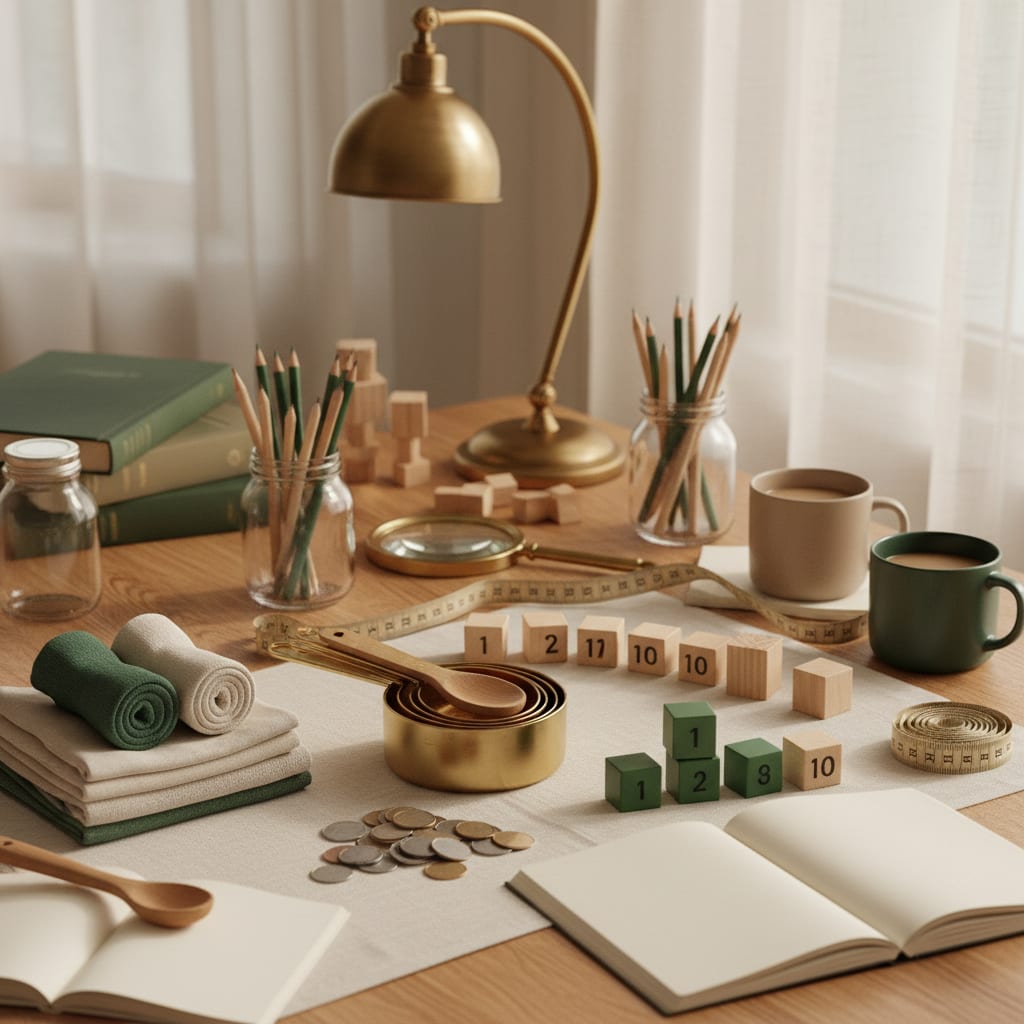
If I could keep only one everyday-math activity, it would be change. Coins are the only common object that teaches place value, unequal units, and mental addition all at once — a nickel is bigger than a dime and worth less, which is exactly the kind of contradiction that forces a child to think in value rather than size.
How we run it: a jar of real coins for sorting and counting, and a set of Learning Resources Pretend & Play Play Money for the games where I don’t want a toddler in the room with quarters. Play store, with actual price tags on actual pantry items. The child is the cashier; you pay with a bill and make them work out the change. Then swap roles, and pay them wrong on purpose — catching the error is the whole lesson.
For the child who needs the abstraction made physical first, base-ten blocks or MathLink Cubes in the 100-count tub bridge the gap: build the number, then trade ten ones for a ten. Coins make sense much faster after that trade is in the hands. And the natural extension is the weekly shop — I’ve written the full route through the aisles in the grocery store as a classroom, which is where unit price, estimation, and budget all live.
Measuring, building, and the math in the yard
A tape measure is a number line that goes places: measure the room, the dog, the driveway, then re-measure the child in a month. Building anything — a birdhouse, a fort — forces perimeter and right angles. And the car is a rolling word problem: “we’ve gone 40 of 100 miles, so what fraction are we?”
Where the worksheet still wins
Say this out loud so no one feels guilty about it: some math is best learned by doing twenty of them in a row.
Math facts need retrieval practice — flash rounds, three minutes, daily. The standard algorithms need sequence and repetition. Long division does not arise organically from laundry. So the shape that works is a short formal block (ten to twenty minutes for a young child, more as they climb) using whatever program you picked, plus a house full of the same ideas in physical form. Our kindergarten build-your-own plan shows how small the daily core can honestly be, and how many hours a day homeschooling takes puts it in the context of a whole schedule.
One more second-gen note: I was taught this way, and what stuck wasn’t any single activity. It was that math was clearly for something. Nobody in our house ever asked when they’d use it, because we used it before lunch.
FAQ: teaching math through everyday activities
Can everyday activities replace a math curriculum?
Not entirely, and I’d be careful with anyone who says otherwise. Real-life math is excellent for number sense, fractions, money, and measurement, but it skips whole strands — regrouping, standard algorithms, systematic fact fluency — that need deliberate sequence. Use a program for the spine and the house for the practice.
What age should I start everyday math?
As soon as a child can carry a sock. Two-year-olds sort, three-year-olds count small sets, four-year-olds match and compare. None of it needs to be called math, and none of it needs a lesson plan — narrate what you’re doing and let them help badly for a while.
My child hates math worksheets. Is real-life math enough?
It’s enough to rebuild the relationship, which matters more than a month of pages. Drop to oral math and household math for a few weeks, keep facts practice short and playful, then reintroduce written work in very small doses — five problems, done together. Refusal is usually about volume and speed, not about math.
How do I do this with a toddler in the room?
Give the toddler the same materials at a lower level — a bowl of her own coins-that-aren’t-coins, her own socks to sort — and accept that the lesson runs in ten-minute pieces. Household math survives interruption far better than a lesson at the table does, which is exactly why it’s the block I schedule for the loud part of the day.