Quiet Time Activities for Big Kids During Nap
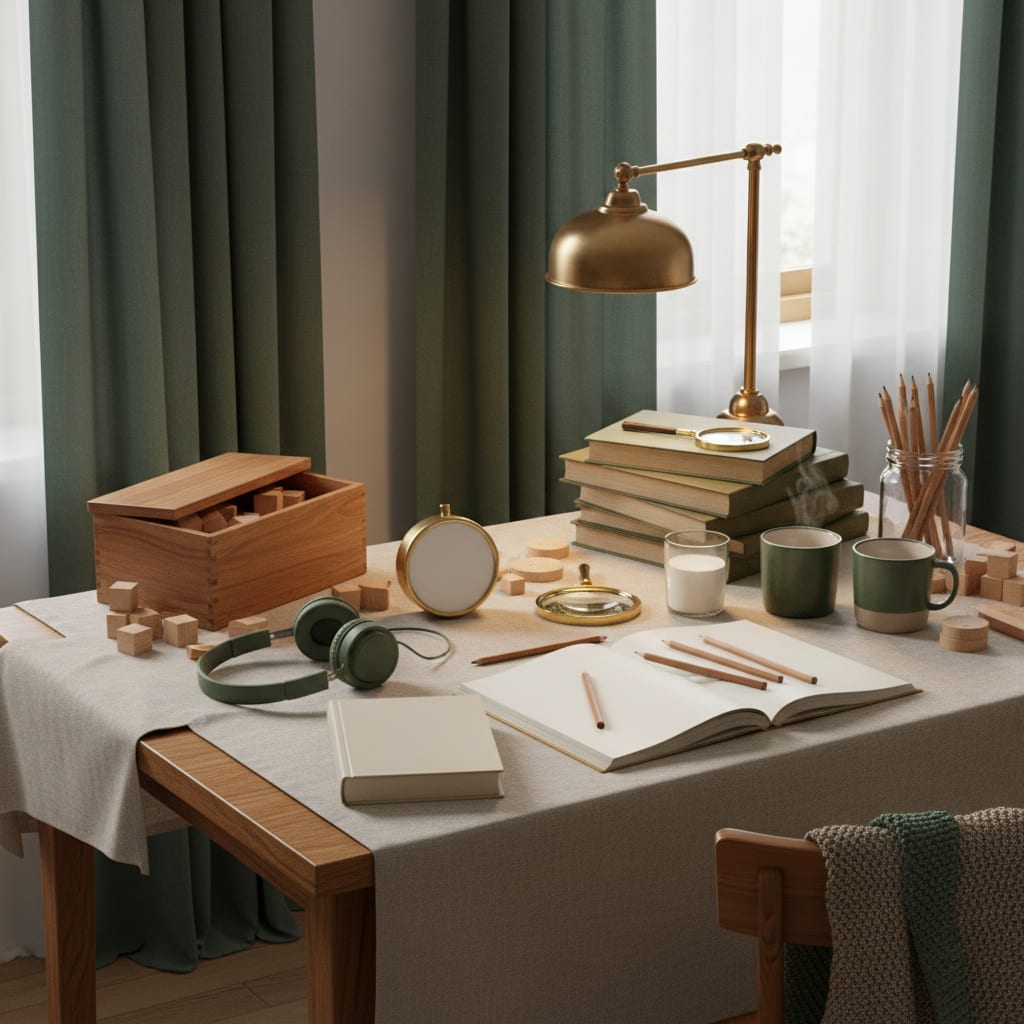
The nap hour is the most valuable teaching block a homeschooling family has, and it only works if the older child has something to do that is genuinely independent and genuinely quiet. The activities that hold up are narrow: silent reading, audio stories with headphones, drawing and building, copywork or a familiar review page, and a rotating box of fiddly, absorbing things kept for this hour only. What breaks the block is anything that generates noise, questions, or a mess needing rescue. Set the boundary in objects and a timer, teach it for a week, and you buy yourself forty-five minutes of one-to-one teaching every single day.
One thing up front, from the seat I’m in — mother of an 8-year-old, a 6-year-old, and a 2-year-old who still naps. Quiet time is a taught skill, not a personality trait, and the first fortnight is the hard part.
Why the nap hour is worth defending
For a homeschool, the toddler’s nap is not downtime — it’s the only block where you can teach one child properly without an interruption every ninety seconds. In our house it’s where reading instruction lives, and when the nap wobbles, phonics wobbles with it. That’s the thesis of homeschooling with a toddler underfoot: the nap is the master schedule.
Which is why the older child’s hour matters so much. If your six-year-old spends the nap hour wandering in to ask questions, you haven’t got a teaching block — you’ve got the same day with a quieter soundtrack.
What quiet time is, and what it isn’t
Define it out loud, in terms a child can enforce on themselves:
- Quiet — no talking to me, no shouting to a sibling, nothing aimed at the sleeping child’s door.
- Independent — nothing that needs me to start it, find pieces for it, or referee it.
- Contained — one agreed place, so cleanup is bounded.
- Chosen — the child picks from a menu. Choice is what turns quiet time from a punishment into a habit.
And what it isn’t: screen time by default (a screen with headphones is a legitimate part of the hour, but the whole hour every day makes it a babysitter), and it isn’t new schoolwork — the nap hour is the wrong slot for anything a child could get stuck on, because getting stuck generates exactly the noise you were avoiding.
The nap-hour list, by age
Ages 4–5. Duplo and blocks on a rug, a bin of magnetic tiles like Magna-Tiles, sticker books, dot markers on plain paper, a puzzle, playdough at the table on a mat, board books, and a picture-book audio recording. Ten to twenty-five minutes is a realistic run; extend it by rotating rather than by insisting.
Ages 6–8. Silent reading (the big one, and worth training explicitly), audiobooks with headphones, drawing and comic-making, LEGO, cutting and folding paper, mazes and dot-to-dots, copywork, a familiar math review page they can already do, and letters to grandparents. This is the age where quiet time becomes genuinely long — forty-five minutes is normal once the habit is in.
Ages 9–12. Independent reading, longer independent assignments, sketchbooks, model-building, sewing or knitting, a musical instrument only if there’s somewhere far away to do it, journaling, and personal projects. At this age, hand them the hour: their work, their order, done by the timer. That’s a school skill in itself.
The middle-child problem. A child too old to nap and too young to work alone — the classic four-year-old — belongs next to you at the table with a fiddly job (threading, sorting, taping) while you teach the older one. Sending them off alone is what fails.
Five rules that make it stick
- The box only appears at the nap hour. Scarcity is the entire technology; an all-day toy stops holding attention.
- Everything is prepped before the toddler goes down. Scissors out, headphones charged. A trip to the cupboard mid-hour costs you the block.
- One question rule. The child gets one round of questions before it starts; after that, questions wait on a sticky note.
- A drink and a snack are already on the table. Roughly a third of quiet-time interruptions are catering.
- Same time, same place, every day. Habit does the enforcement so you don’t have to.
Expect to actively teach the routine for a fortnight: start at ten minutes, sit nearby, extend by five at a time. Families who abandon quiet time nearly always abandon it in week one, on the evidence of a child who hasn’t learned it yet.
The timer does the arguing for you
The highest-return purchase for a quiet hour is a visual timer — a clock face where a colored disc shrinks as time passes, so a child who can’t read a clock can see how much is left. It removes the “how much longer?” conversation, which is the interruption that costs you most. The Time Timer is the canonical one; a kitchen timer works nearly as well once a child tells time. Set it a few minutes shorter than the nap you expect, so quiet time ends on your terms rather than the toddler’s.
Audio is the second lever: a story on headphones holds a six-year-old longer than anything else in the house, costs nothing at the library, and leaves no wound-up child at the end of it. Where screens belong in a homeschool day, and why the youngest child pays for them, is worked through in homeschool screen time and toddler sleep.
When the nap gets short — or ends
Two different problems with two different answers.
If the nap is suddenly forty minutes when it used to be ninety, that’s usually a sleep problem rather than a quiet-time problem, and it’s worth reading up on why naps go short before you rebuild your whole schedule around the new shorter one. Overtiredness, an outgrown wake window, and a room that’s got lighter with the season all produce the same forty-minute nap.
If it’s shrinking steadily over weeks, you may be inside a genuine nap transition — two naps collapsing to one, or one nap on its way out — in which case the fix is the schedule, not the child. Either way, plan the school day against the nap you actually have, and re-check that assumption each term.
When our third’s nap started moving last winter, my read-aloud block went with it, and I got systematic about her sleep for entirely selfish curricular reasons. We used Betteroo, a personalized sleep program — a quiz about your child and your approach, then a day-by-day plan for nap timing and bedtime that adjusts as she changes. House verdict stands: a tool, not magic, around $20 a month, and a settled napper makes it unnecessary. What it bought us was a nap we could timetable against.

And when the nap finally goes for good, keep the block: the toddler gets a fixed quiet hour in her own room, same time, timer running. The quiet hour outlasts the nap by years, and by then the older children already know how to use it — which is what keeps the school day’s real arithmetic, set out in how many hours a day homeschooling takes, from quietly falling apart.
FAQ: quiet time during the baby’s nap
Quiet time is taught like any other routine: a fixed time and place, a menu of contained activities the child chooses from, a visible timer, and a short run extended gradually — with about two weeks of active teaching before it runs itself.
How long should quiet time be for a 6-year-old?
Thirty to forty-five minutes is a realistic target once the habit is established, starting from ten or fifteen. Match it to the nap you actually get rather than the one you want, and end it slightly early rather than late.
What if my older child refuses to stay quiet?
Shorten it dramatically — five minutes, sat beside you — and rebuild. Refusal is nearly always a sign the block was too long or too dull to begin with, not defiance.
Should quiet time be in the child’s own room?
Anywhere works as long as it’s consistent and far enough from the sleeping child. A separate room gives the most independence; the kitchen table gives you the most oversight, which matters more at five than at nine. A screen with headphones is fine as part of the hour — the nap is the one genuinely free screen slot in a homeschool day, because the child you’re protecting is asleep.