Loop Scheduling: The Flexible Homeschool Fix
A loop schedule is a list of subjects you work through in order, picking up wherever you stopped last time, instead of assigning each subject to a fixed day. Science, history, art, geography and music go on one list; you do one or two per day, and tomorrow you start at the next line rather than at the top. Miss a day and nothing is skipped — everything just arrives slightly later. It’s the single easiest fix for the subjects that keep getting bumped, and it takes about ten minutes to set up.
The reason it matters is arithmetic. A five-day timetable with art on Friday means that four cancelled Fridays equals a month with no art. A loop means art is simply next.
What loop scheduling actually is
Imagine a numbered list taped inside a cupboard door:
- History
- Science
- Art
- Geography
- Music
- Nature study
Monday you do history and science. Tuesday you get to one thing, so art. Wednesday is a wash — dentist. Thursday you pick up at geography and music. Friday: nature study, then back round to history. Nobody ever “misses” science; the loop just turns more slowly that week.
That’s it. There is no clever part. The clever part is what it removes: the mental ledger of everything you didn’t do, which is the actual reason people quit.
Why the loop beats a fixed timetable
Three reasons, in order of how much they matter.
It converts guilt into position. On a timetable, an interrupted week produces a list of failures. On a loop, it produces a bookmark. Same week, same amount of work done — completely different feeling on Sunday night, and that feeling is what determines whether you’re still homeschooling in March.
It self-corrects for the subjects you avoid. Everyone has one — the one that needs supplies, or a mess, or your own weak spot. On a timetable you can dodge it for a term without noticing. On a loop it sits there as the next line, and you either do it or you consciously delete it. Both are honest; drifting isn’t.
It handles unequal subjects gracefully. A nature walk takes ninety minutes; a poetry reading takes six. A timetable pretends they’re the same size. A loop doesn’t care.
There’s a limit to what a scheduling trick can fix, though. If you’re dreading the whole week rather than one subject, that’s not a loop problem — that’s homeschool burnout, and the answer there is a break, not a better list.
Setting up your first loop
- List the subjects that are not daily. Math, reading and writing stay daily; they’re skills that decay without repetition. Everything else is a candidate.
- Write them in one column, in whatever order. Order matters less than you think — the loop scrambles it within a fortnight anyway.
- Decide how many loop items per day. One is plenty in early elementary; two is normal by nine or ten.
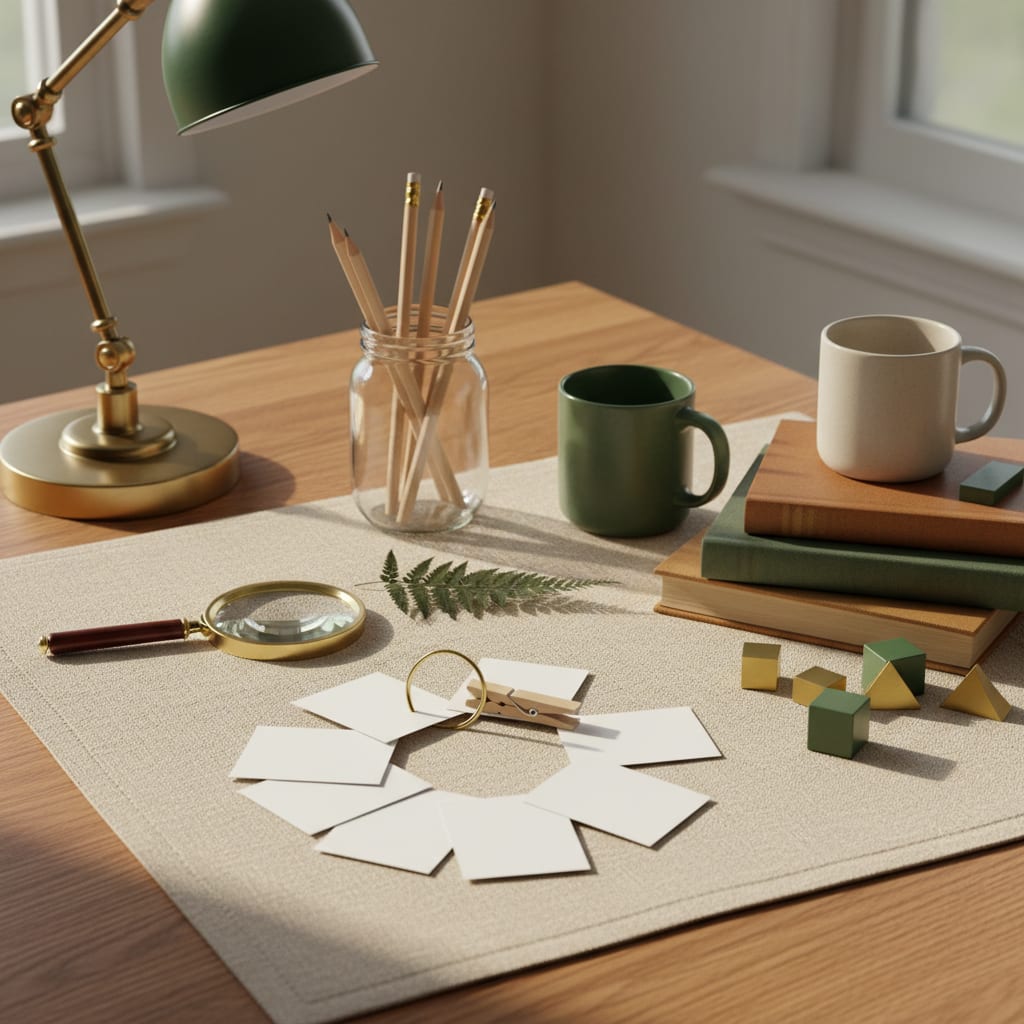
- Put the list somewhere physical. Inside a cupboard door, on a ring of index cards, on the fridge. Digital lists lose to a piece of card here, in my experience, because the loop’s only mechanism is that everyone can see where the bookmark is.
- Mark your place, not the date. A paperclip, a clothespin, a child’s finger. The moment you start writing dates next to loop items you’ve rebuilt the timetable you were escaping.
Ten minutes. Then leave it alone for a month before you judge it.
What belongs in a loop, and what never does
Good loop candidates: history, science, geography, art, music, nature study, poetry, picture study, logic, typing, life skills, foreign language exposure (not formal study), and anything you describe with the words “we really should do more of.”
Terrible loop candidates: math, phonics, spelling and handwriting. These are skill subjects: they build by short, frequent repetition, and a loop turns “ten minutes daily” into “forty minutes every fourth day,” which is measurably worse for retention and much worse for morale. The same goes for anything with an outside deadline — a co-op class, a sport, an online course with a submission date.
The rule of thumb I use: if missing four days in a row would set the child back, it’s daily. If missing four days in a row just means less of it, it’s loopable.
A caveat about curriculum. Some programs are written as a sequence with a fixed number of lessons per week and a spiral built into that cadence; dropping them into a loop breaks their internal logic. Read the teacher’s guide before you loop a boxed program, and if the pacing is load-bearing, loop around it instead. Which programs work that way is part of what you’re actually choosing between in how to choose homeschool curriculum.
Loop scheduling with a toddler in the house
This is where loops earn their keep, and it’s why we use one.
With a two-year-old in the house, roughly one day in four goes sideways for reasons that have nothing to do with school. A timetable makes those days into deficits. The loop makes them into a slower week, which is the accurate description.
Two practical adjustments. First, sort your loop by mess: put the pourable, cuttable, gluable items in the nap block and the read-and-discuss items in the morning, so a bad nap costs you a paint session rather than the whole afternoon. Second, keep the loop short. Six items is a loop; fourteen items is a wish list, and a fourteen-item loop with a toddler means each subject comes round about once a month, which is the same as not doing it.
Three ways loops fail
The loop gets too long. Every appealing subject you’ve ever read about goes on the list, the cycle stretches to three weeks, and continuity dies. Cap it at six or seven, and hold a second list of “someday” items that swaps in when something finishes.
Nobody moves the marker. If the bookmark isn’t physically moved at the end of each session, within a fortnight you’re guessing, and guessing reintroduces the ledger. Make moving the clip a child’s job — mine fight over it.
It swallows subjects that needed a deadline. A loop has no calendar, so anything with an external date must sit outside it. Put dated commitments on the wall calendar and let the loop fill the space between them.
Loops also pair well with a four-day week: four teaching days, one open day, and the loop absorbing whatever the open day displaced. That whole structure — the blocks the loop sits inside — is in our homeschool schedule, and if you’re using a loop across a full twelve months rather than a nine-month year, the rhythm changes again in year-round homeschooling.
FAQ: loop scheduling
Loop scheduling means working through an ordered list of non-daily subjects and resuming at the next item after any interruption, rather than assigning subjects to fixed weekdays — so a missed day delays the rotation instead of deleting a subject.
How many subjects should be in a homeschool loop?
Five to seven for most families. Fewer than four and you may as well use a timetable; more than eight and each subject comes around too rarely to build on itself. Count how many items you can genuinely reach in a fortnight and cap the loop there.
Can you loop math or reading?
Not usefully. Skill subjects need short daily repetition, and looping them concentrates the same minutes into rarer, longer, more tiring sessions. Keep math, phonics, spelling and handwriting daily, and loop the content subjects around them.
What if we get stuck on the same loop item?
Split it. A single “science” line that always takes two sessions should become two lines — “science reading” and “science experiment” — so the marker can move at the end of a normal session instead of hanging in the same place.
Do you loop by day or by session?
By session. If you fit two loop items into a morning, move the marker twice. Tying the loop to days rather than to completed sessions quietly turns it back into a timetable, which is the exact thing you were trying to escape.