Do You Need a Preschool Curriculum? Mostly No
For most three- and four-year-olds, no — a preschool homeschool curriculum is optional, and skipping it costs a child nothing. What preschoolers actually need is talk, being read to daily, unstructured play, time outdoors, and the fine-motor work that happens through cutting, digging, drawing, and dressing themselves. None of that requires a purchased program. There are three honest reasons to buy one anyway: you want a structure to follow because unstructured days undo you, your four-year-old is asking for “school” because the older ones have it, or you’re in a charter or program that requires documented materials. Those are real reasons. “Falling behind” is not one, at four.
I say this having been both the child taught with nothing formal until five and the mother who bought a preschool program for her second child anyway — for the third of those reasons, which is that a four-year-old watching two siblings do school will not accept “you’re too young” as an answer.
What a preschooler is actually working on
The developmental list is short and almost entirely non-academic:
- Language. Volume of conversation and being read to daily are the two biggest predictors anyone can influence at home. Narrate, ask real questions, and read past their attention span occasionally.
- Fine motor. Scissors, tongs, playdough, buttons, zips, and drawing — the physical foundation for handwriting later, built years before a pencil grip matters.
- Gross motor and outside time. Climbing, balancing, carrying heavy things. Not filler; the body is doing coursework.
- Play, especially with other children. Turn-taking, negotiating, losing at things, pretending.
- Pre-literacy by exposure. Rhymes, songs, noticing letters in the world, hearing sounds inside words. Formal phonics can wait until there are signs of readiness.
- Counting things that exist. Stairs, apples, socks. Quantity before symbols.
Almost all of it happens in an ordinary day at home with a parent who talks. That’s the entire case for skipping the box.
When a boxed preschool program earns its place
Three situations where buying one is a sensible planning decision rather than a fear purchase:
You need the structure more than the child does. A parent facing a long day with a preschooler and no plan will often do less, not more. A twenty-minute open-and-go program is worth buying purely as a scaffold for the adult, and there’s no shame in that being the reason.
There’s an older sibling doing school. The “me too” problem is universal, and the solution is to give the four-year-old a folder of their own with real-feeling work in it, timed to the block where you most need everyone occupied. This is the same mechanism as the school-time-only bins in homeschooling with a toddler underfoot — the novelty and the ceremony are doing most of the work, not the content.
Documentation. If you’re enrolled with a charter, umbrella, or program that expects listed materials, buy something that produces a paper trail. Where any requirement is involved, verify what your own state or program actually asks for at the source — that’s the two-source method in finding your state’s homeschool rules, and it applies to preschool documentation as much as anything else.
What isn’t a good reason: the fear that a five-year-old who can’t read is behind. Reading ages vary enormously among children who all end up fluent, and formal instruction started at four rather than six confers no durable advantage for most kids.
What to buy instead, if you’re buying
A short list, chosen so nothing here is single-use:
- Library books, weekly. The highest-return “curriculum” available and free. Twenty picture books a fortnight beats any preschool box.
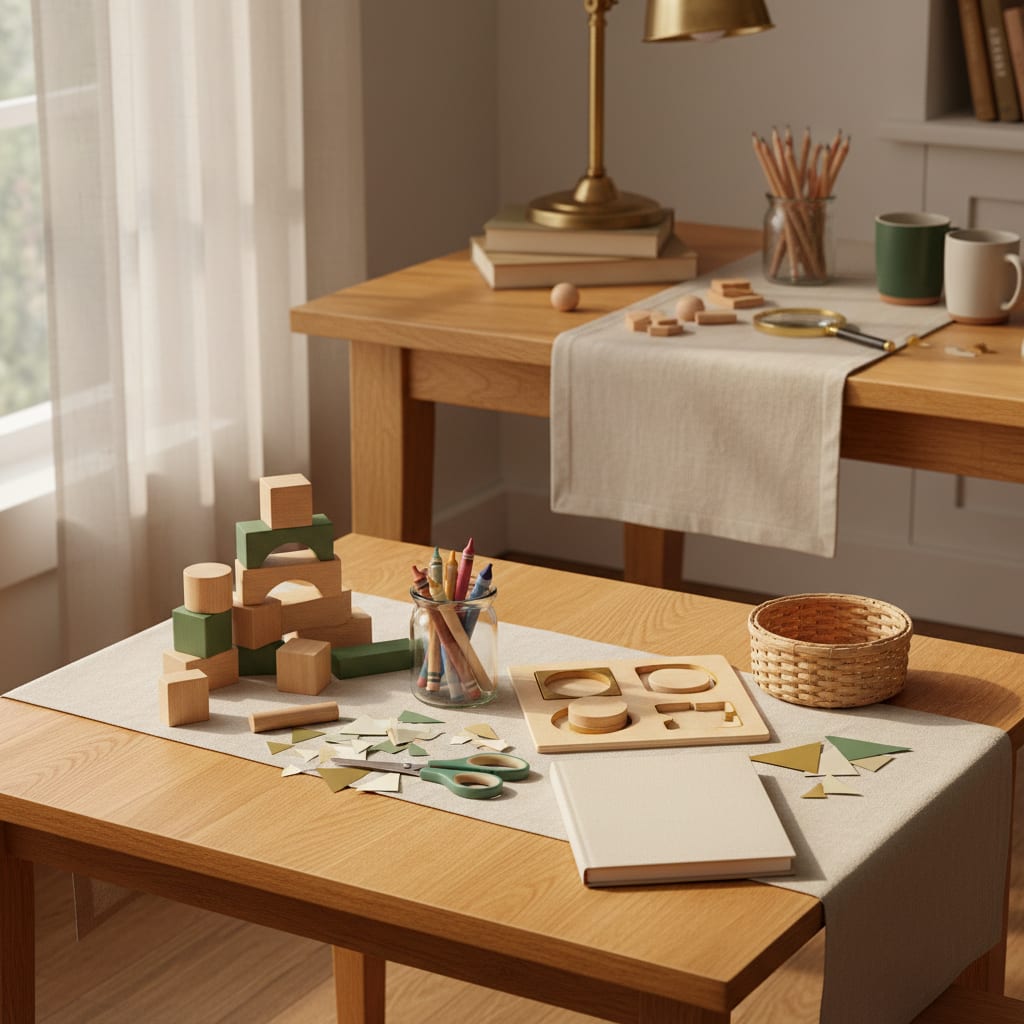
- A good block set. Open-ended, used for years, and quietly the best early maths material there is — sorting, symmetry, balance, quantity, spatial reasoning. A classic hardwood set like Melissa & Doug’s 100-piece wooden blocks is the canonical worked example: four colors, nine shapes, indestructible, and it will still be in use when the child is eight.
- Basic art and fine-motor supplies. Fat crayons (such as Crayola Large Washable Crayons), child scissors (such as Fiskars 5-inch blunt-tip scissors), glue, playdough, a bin of tongs and pom-poms. This is the whole “fine motor curriculum.”
- Puzzles and a few sorting toys. Rotated, not all out at once.
- Optionally, a phonics readiness resource you can start whenever the child shows signs — rhyming, hearing initial sounds, asking what words say. The sequence, when the time comes, is in teaching your child to read at home.
Montessori-minded families run a more structured version of the same ideas with defined materials and a prepared shelf; that’s a whole tradition of its own and my colleagues at Montessori Bloggers Network cover it far better than a general homeschool site can.
What “preschool at home” looks like on the day sheet
Planning-shaped, because that’s what’s useful: give the preschooler a place in the day rather than a subject list. In our house that’s twenty minutes at the table while the older two do independent work — a puzzle, a drawing, a stack of stickers, or the folder if they want it — followed by outside, followed by lunch. Ten to twenty minutes of anything table-shaped is a full preschool day at four. If they want more, let them have more; if they want to leave after six minutes, they’re finished.
The thing to protect is that preschool doesn’t start eating the day. A preschool program that needs prep, printing, and forty minutes of your direct attention is competing with your first-grader’s reading lesson, and the first-grader has to win. Keep the preschool block small enough that skipping it entirely on a bad day is a non-event.
Signs a four-year-old is ready for more
Follow the child, not the birthday. Readiness usually looks like: asking what words say, writing letters unprompted (backwards is fine), noticing that two groups of things are the same size, sitting through longer read-alouds, or explicitly asking for school. When several of those arrive, move up — start the kindergarten-shaped work rather than buying a bigger preschool box. What that costs and contains is set out in building your own kindergarten curriculum, which is the natural next step and, at that age, still mostly not a purchase.
FAQ: preschool homeschool curriculum
Preschool at home doesn’t require a purchased curriculum for most families — reading aloud daily, talking constantly, open-ended play, outdoor time, and fine-motor activities cover what a three- or four-year-old is actually developing. A program is worth buying when the parent wants structure, a sibling situation demands it, or documentation is required.
At what age should we start formal schoolwork?
Most families begin something recognizably formal somewhere between five and six, and children who start later routinely catch up within a year. Short daily sessions started at the right time beat long sessions started early.
How long should a preschool “lesson” be?
Ten to twenty minutes, once a day, ending before the child is done rather than after. Table time at four is about building the habit of sitting down, not covering content.
Is my child behind if they aren’t reading at five?
Almost certainly not. The normal range for fluent reading is wide, and a five-year-old who isn’t reading yet is squarely inside it. Watch for signs of readiness rather than the calendar, and get a hearing and vision check if you’re genuinely concerned.
Should I buy the same publisher’s preschool level as our main curriculum?
Only if you already like their format and it’s cheap. Preschool levels are the least differentiated products publishers sell, and brand loyalty at this stage buys you very little.