Teaching Handwriting Without the Tears
Handwriting is taught in ten minutes a day, not thirty, and the ten minutes should come after the fine-motor work rather than instead of it. Start letter formation somewhere around five or six, teach capitals before lowercase, teach each letter as a movement you say out loud rather than a shape to copy, and stop the session while the child is still writing well. Almost every handwriting battle I’ve watched — including two of my own — came from a page that was too long, started too early, or asked for neatness the hand could not yet produce.
The good news is that this is one of the few homeschool subjects where the research-backed approach and the cheap approach are the same approach.
When to start, and when not to
Formal letter formation is a fine-motor task before it’s an academic one. The muscles that hold a pencil are the same ones a child builds by squeezing, pinching, tearing and climbing, and no amount of tracing practice substitutes for them.
Broad, hedged guide, because children vary enormously:
- Ages 3–4: no formal handwriting. Drawing, playdough, tearing paper, tongs, big vertical scribbling on an easel.
- Ages 4–5: capital letters, big, on unlined paper or a whiteboard. Ten minutes, three or four days a week.
- Ages 5–6: lowercase, then simple words, on wide lines.
- Ages 6–8: consolidation, spacing, speed. Cursive is a live option any time from here.
If a five-year-old cannot yet do the physical prerequisites — hold scissors properly, do up a button, make a fist and release it smoothly — do those for another term and come back to letters. You will lose nothing and avoid a year of resistance. This ordering is the same reason our kindergarten plan puts so little formal writing in the day.
The fine-motor work that comes first
Five minutes of this before the pencil comes out changes the handwriting more than five extra minutes of writing would:
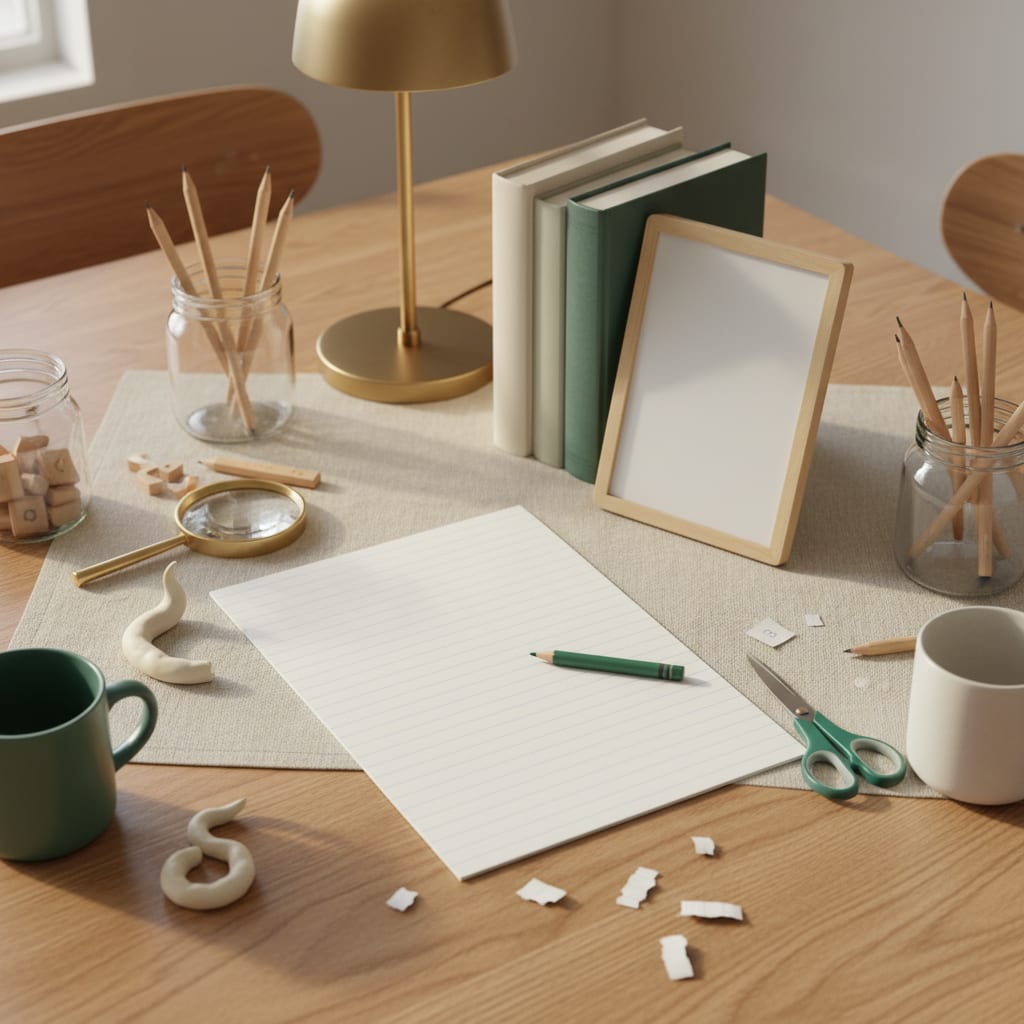
- Playdough: rolling snakes, pinching, hiding beads inside and digging them out.
- Tongs and tweezers: moving pom-poms between bowls. Deeply boring to adults, weirdly compelling to five-year-olds.
- Vertical surfaces: chalk on a fence, paint on an easel, paper taped to a wall. Working upright builds wrist stability in a way tabletop work doesn’t.
- Scissors: the single most useful fine-motor tool in the house.
- Spray bottles, hole punches, clothespins, threading beads, tearing paper into strips.
Also worth saying plainly: children who climb, hang and carry heavy things generally have better handwriting than children who don’t. Shoulder and core strength sit underneath everything the hand does. An outdoor morning is not time taken away from handwriting.
Print or cursive first?
Honest answer: both camps have reasonable arguments and the evidence isn’t decisive enough for me to be dogmatic about it here.
Print first is the mainstream sequence. It matches what the child is simultaneously learning to read, which reduces the load in the year they’re decoding, and it’s what most reading programs assume. This is what we did.
Cursive first has a real case: the continuous stroke removes the need to lift and re-place the pencil, the letters are harder to reverse because they start in different places, and children who begin with cursive never have to unlearn print habits. Families who go this route usually start around six.
What matters more than the choice: pick one, teach it as movement with verbal cues (“start at the top, down, around”), and don’t switch halfway through a year. Whichever you pick, the child will need to read the other one, which they’ll pick up incidentally from books and grandparents’ letters.
A ten-minute daily routine
- Two minutes of warm-up. Playdough, tongs, hand-shaking, or writing giant letters in the air with a whole arm.
- One letter modeled by you. Say the movement while you write it. The child watches, doesn’t copy yet.
- Three or four in the air or on a whiteboard. Big, then smaller. Wipe-off surfaces are less intimidating than paper because a bad one disappears.
- Four to six on paper. Not a full line. Four good letters teach more than a row of twenty deteriorating ones.
- The child picks their best one and circles it. Self-assessment, ten seconds, and it moves the conversation from my judgment to their eye.
- Stop. While it’s still going well. This is the rule people break.
Two or three times a week, add a short piece of copywork — one sentence from the read-aloud — so the handwriting has a reason to exist. That’s also where handwriting starts feeding spelling and composition, which is why it belongs next to reading rather than off on its own; the sequence it sits inside is in teaching your child to read at home.
Fixing a grip, a reversal, or a refusal
The grip. The tripod grip — thumb and index finger holding, middle finger supporting — is what you’re aiming for, but a functional four-finger grip that doesn’t tire the child is not worth a war. Short pencils and broken crayons force a tripod grip better than any plastic gadget, because a two-inch crayon physically cannot be fisted.
Reversals. Confusing b and d, or writing 3 backwards, is developmentally ordinary well into age seven. Teach the pair separately with a physical cue rather than a rule, cover the confusable letter’s twin while practicing, and don’t correct every instance in a piece of writing — pick one. If reversals are still frequent and effortful past seven or eight, or if writing is painful, it’s reasonable to ask your pediatrician about an occupational therapy assessment. That’s a signpost, not a diagnosis; I’m not qualified to give you one.
Refusal. Nearly always a length problem or a fatigue problem in disguise. Cut the session to four letters. Let the child dictate while you scribe so composition can keep developing while the hand catches up — separating “having ideas” from “forming letters” defuses more handwriting standoffs than anything else I’ve tried.
What to buy, and what to skip
A workbook is genuinely useful here, more than in most subjects, because letter sequence and stroke order are exactly the kind of thing that benefits from someone having thought it through. The Learning Without Tears series is the one that comes up most often among homeschoolers and occupational therapists; My Printing Book is the first-grade print workbook, and its two-line format is noticeably less busy than standard three-line paper for a child who’s overwhelmed. Zaner-Bloser and the various cursive-first programs are reasonable alternatives; how to compare programs like this without buying four of them is the whole subject of how we chose our first-grade curriculum.
Worth owning: a small whiteboard like a Scribbledo 9x12 board, a chunky pencil or two such as Ticonderoga My First pencils, and blank unlined paper. Worth skipping: plastic pencil grips as a first resort, laminated tracing sheets used with dry-erase markers as a daily program, and expensive posture cushions. Cheap and short beats elaborate and long, every time.
FAQ: teaching handwriting at home
Handwriting is best taught in about ten minutes a day: a short fine-motor warm-up, one letter modeled aloud as a movement, a handful of practice repetitions rather than full lines, and an early stop while the child is still writing well.
At what age should a child start handwriting?
Formal letter formation usually suits five- to six-year-olds, with capitals before lowercase. Before that, build the hand with playdough, scissors, tongs and vertical drawing. Starting late costs almost nothing; starting too early can cost a year of resistance.
How long should a handwriting lesson be?
Ten minutes at five or six, fifteen by seven or eight, including warm-up. Quality collapses well before children admit they’re tired, which is why stopping early is a technique rather than a kindness.
Should I teach cursive at home?
It’s optional and not required everywhere, but many homeschoolers teach it around seven or eight — some earlier, as a first script. The practical arguments are pencil economy and letter distinctness; check whether your state’s or your umbrella program’s requirements mention it before deciding.
My child hates handwriting. What now?
Shorten the session drastically, move to a whiteboard, and let them dictate their ideas to you while the hand catches up. Then check the mechanics: pencil too long, paper untilted, chair too high, feet unsupported. Physical setup accounts for more handwriting misery than attitude does.