Letter of the Week: A Simple Homeschool Preschool Plan
A letter of the week plan introduces one letter each week, roughly 26 weeks for the alphabet, with a few short activities built around it. For a homeschooled four- or five-year-old it is a perfectly good plan, as long as you change three things from the classroom version. Teach the letter’s sound, not just its name. Use an order that lets the child build real words by the second month rather than going A to Z. And stop every few weeks to review instead of starting a new letter. Ten minutes a day is plenty.
Everything below is a planning shape rather than a curriculum you need to buy. If you are still deciding whether a preschooler needs anything formal at all, start with do you need a preschool curriculum. My answer there is “mostly no,” and this plan is for the child who has started asking what the letters say.
The honest critique: one a week is slow
Letter of the week is popular because it is easy to plan, but not every reading expert is a fan. Timothy Shanahan, a literacy researcher who answers teachers’ questions on his Shanahan on Literacy blog, took up a district’s pacing question in a post titled Why Letter of the Week May Not Be Such a Good Idea. He opens by saying pacing is “not the type of question that research takes on,” so any answer is judgment, not proof.
His judgment is worth borrowing, though. He suggests one or two letters a week, with some weeks where no new letter comes in, and those weeks are spent using the letters already taught: hearing the sounds in words, blending them, building and spelling small words. His worry is that a steady new-letter-every-week march produces children who can name the letter but not do anything with it. At home that is easy to act on: you can see who is ready and take a review week whenever one is needed.
Choosing an order: A to Z or sound-first
A to Z is the order children already sing, and that is its only real advantage. Many phonics programs use a different sequence. England’s widely used Letters and Sounds programme is a well-documented example (Oxford Owl’s overview lists it). It starts with s, a, t, p, then i, n, m, d, then g, o, c, k. Phonics Bloom’s explainer on that first phase gives the reason in one line: those first four letters “can be used to make seven words: a, at, as, sat, pat, tap, and sap.” A child who knows four sounds can read a word. A-to-Z order, by contrast, leaves two of the most useful sounds, s and t, until weeks 19 and 20.
The same explainer notes that these programmes teach lowercase first, and the letter’s sound rather than its name. You don’t have to copy any programme’s order. The principle is what matters: early letters that combine into words, vowels spread out, and look-alikes such as b and d kept apart.
A 26-week letter of the week plan
This is our plan, built on that sound-first logic. It fits all 26 letters into 26 weeks by doubling up on some later consonants, with a review week after every few letters. The right-hand column is the whole point: it is what the child can build by that week.
| Week | New letter(s) | Words the child can build by now |
|---|---|---|
| 1 | s | the sound only: hiss like a snake |
| 2 | a | as |
| 3 | t | at, sat |
| 4 | p | pat, tap, sap, sat |
| 5 | Review | build and read every s-a-t-p word |
| 6 | i | it, is, sit, tip, pit |
| 7 | n | in, an, pin, nap, tin |
| 8 | m, d | man, mat, dad, sad, mid |
| 9 | Review | mix all eight letters |
| 10 | o | on, not, top, pot, dot |
| 11 | g, c | dog, cat, cap, got, cot |
| 12 | k, e | kit, pet, ten, net, den |
| 13 | Review | sort words by vowel: a, i, o, e |
| 14 | u | up, sun, mud, nut, cup |
| 15 | r, h | rat, run, hat, hot, hug |
| 16 | b, f | bat, bed, fan, fig, fun |
| 17 | Review | b and d on separate days |
| 18 | l, j | lap, leg, jam, jog, jet |
| 19 | w, v | wet, win, van, vet |
| 20 | Review | read short word lists aloud |
| 21 | y, z | yes, yam, zip, zap |
| 22 | x, qu | box, fox, six, quit |
| 23 | Review | the letters that still wobble |
| 24 | Capitals, first half | match each capital to its lowercase |
| 25 | Capitals, second half | find capitals in a picture book |
| 26 | Review | read a first decodable book together |
If a review week shows a letter hasn’t stuck, take a second one. Adding a week costs nothing.
What one week holds
Each day is about ten minutes, and it should end before anyone is tired of it. Here is a week for the letter n:
| Day | Ten minutes on the new letter |
|---|---|
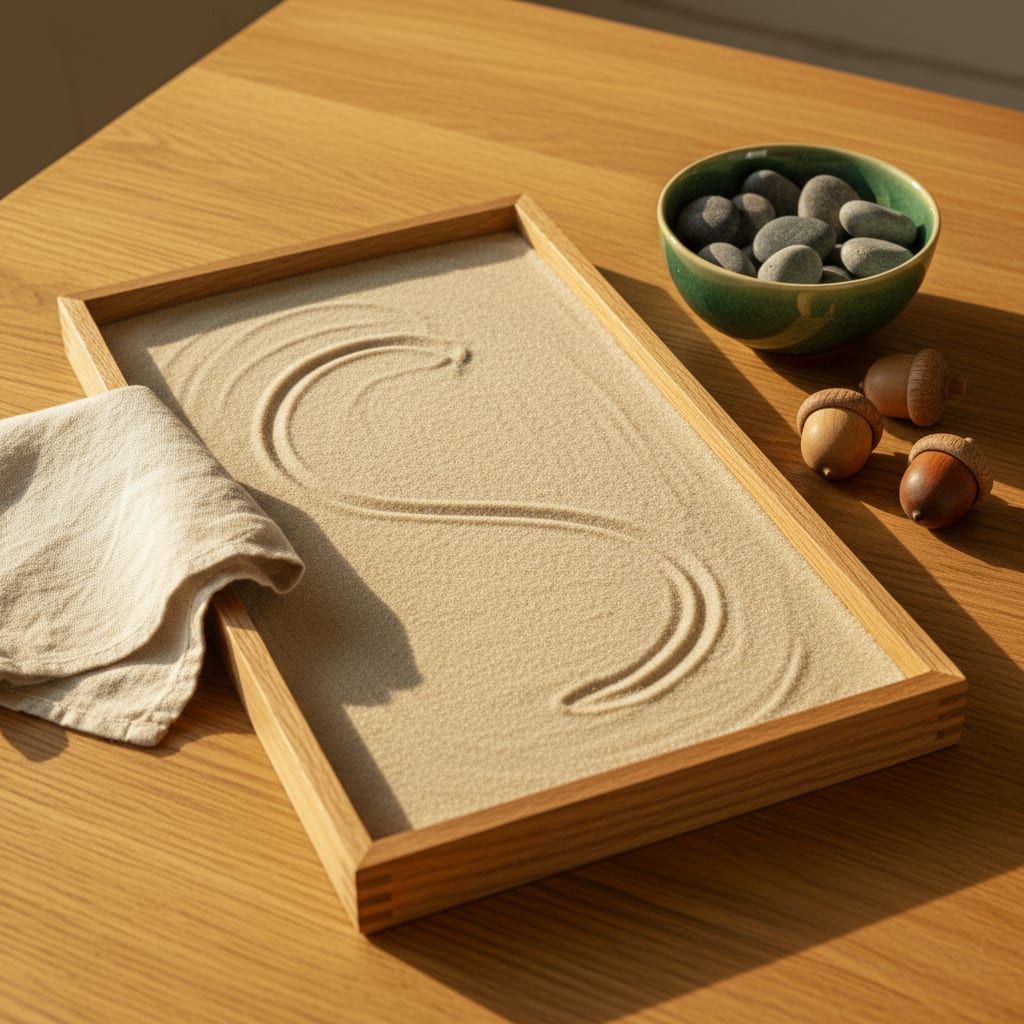
| Monday | Meet the sound: /n/ in nose, nap, nest. Trace a big n in a salt tray. |
| Tuesday | Sound hunt: find three things in the house that start with /n/. |
| Wednesday | Build words. Lay out s, a, t, p, i, n and make in, pin, nap, tin. |
| Thursday | Sort /n/, /s/ and /t/ objects into piles by first sound. |
| Friday | Read aloud, then build three words from any letters learned so far. |
For Wednesday, lowercase magnetic letters with several copies of each letter beat cards, since dad and pop need two of the same letter. The Learning Resources Magnetic Learning Letters is a 104-piece lowercase set that does this, and the fridge door is all the board you need.
Letter of the week activities that earn their ten minutes
The activities that work at this age are the ones where the child hears the sound or uses the letter:
- I spy by sound. “I spy something that starts with /m/.” It works in the car and needs no materials.
- Sound sorting. Put a handful of small objects into piles by their first sound.
- Word building. Change one letter at a time: sat to pat to pit to pin. This is the step that turns letter knowledge into reading.
- Salt or sand trays. Writing the letter large with a finger is how it becomes a shape the child knows.
- Letters in the wild. Point out the week’s letter on shop signs and cereal boxes. The grocery store is especially good for this.
Crafts, such as gluing cotton balls onto a big S, are fine, but they practise scissors and glue, not the sound. Forming the letter on paper is optional at four. Our handwriting guide explains why a four-year-old’s hand usually does better with big capitals on unlined paper or a whiteboard before any lined paper.
When to skip it, or finish early
- The child already knows the sounds. Skip ahead to blending and decodable books.
- The child is three and uninterested. Stop. Read aloud, rhyme and sing, and try again in a few months. Nothing is lost.
- You’re building a full kindergarten year. Build your own kindergarten curriculum shows how it fits beside math, read-alouds and everything else.
FAQ: letter of the week at home
What age should you start letter of the week?
Start when the child shows interest, usually around four. In England, Letters and Sounds places the first letter sets at roughly age 4 to 5, in the first term of Reception. At home, follow the child rather than the birthday.
Which letter should you teach first?
A letter whose sound is easy to hold and hear, and that combines quickly into words. That is why many phonics sequences start with s, a, t and p. Starting with the first letter of the child’s name is also a fine motivational choice.
Should you teach capital or lowercase letters first?
For reading, lowercase, since almost everything in a book is lowercase. Capitals can come later as matching pairs. That is what weeks 24 and 25 of the plan above are for.
Is one letter a week too slow?
For many children, yes, which is why this plan doubles up later consonants and builds in review weeks. If your child is keeping up easily, move to two new letters a week. If they’re struggling, add another review week.