Homeschool Science Without a Lab (Kitchen Counts)
You do not need a lab to teach elementary or middle-school science at home. You need a kitchen, a window, about a dozen cheap items, and a habit of asking “what do you think will happen?” before anything is poured. Real science at this age is observation, prediction, controlled comparison and recording — none of which require equipment. The lab bench matters at high-school chemistry and biology, and even then most homeschoolers meet it through a co-op class, a community-college course or a lab kit, not a room in the house.
I say this as someone taught science at a kitchen table in rural Wisconsin who then took university lab courses and coped fine. What I was short of was not equipment. It was the habit of writing down what I saw before I decided what I thought.
You already own the lab
Walk into your kitchen and inventory it as a scientist. Heat source. Cold source. Running water. Scales. Measuring vessels. Timers. A window with light. Fat, salt, sugar, acid, base — vinegar and baking soda between them cover most of elementary chemistry. Yeast, which is a live organism you can feed. Ice, which changes state on demand.
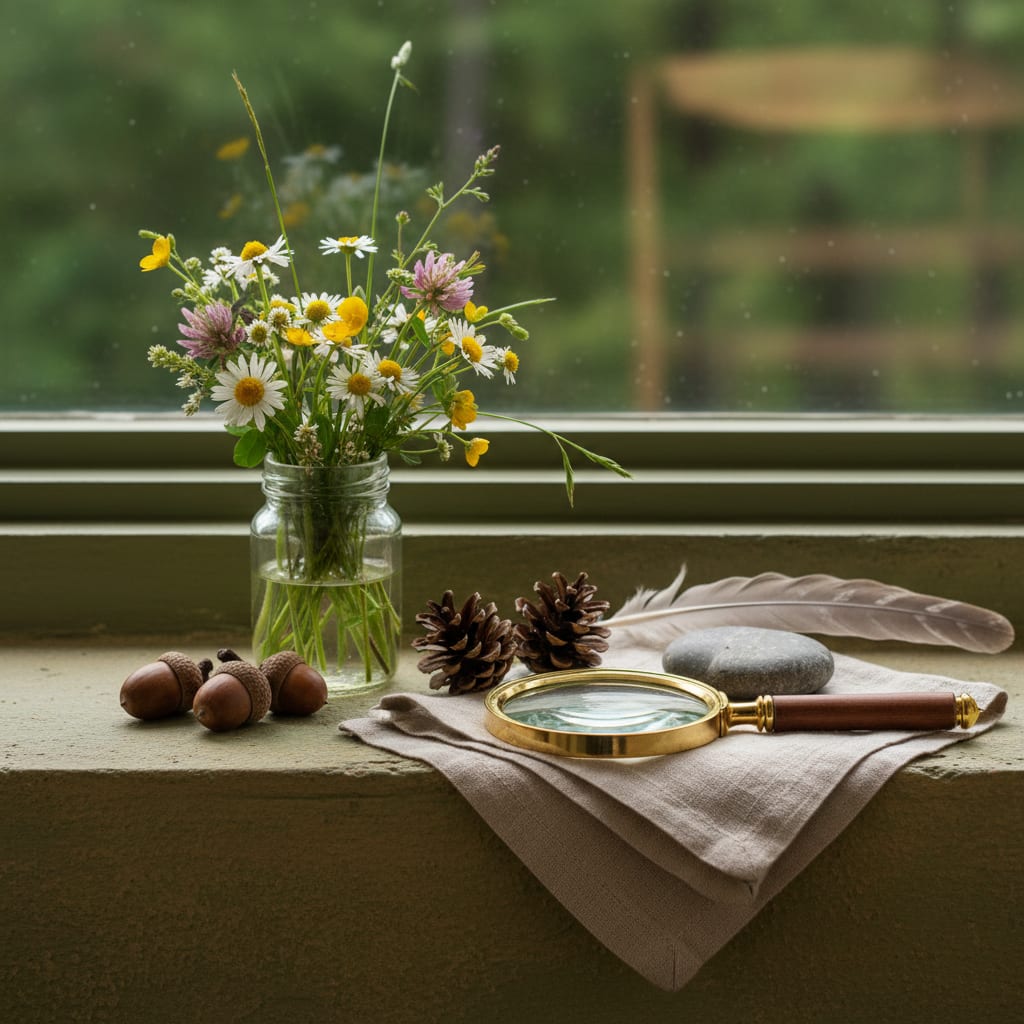
Add a yard, a park or a strip of weeds by the driveway, and you have a biology field site with seasons built in. The constraint on homeschool science almost never turns out to be the stuff. It’s that nobody wrote down what happened.
What elementary science actually requires
Strip away the branding and the science standards for these ages come down to four skills.
Observing carefully. Slower and more specific than children want to be. “It got bubbly” becomes “bubbles started at the edges about ten seconds after I poured, and stopped after about a minute.”
Predicting before acting. The prediction is the entire pedagogical payload. A prediction that turns out wrong is worth three demonstrations that go as expected, because being wrong is what makes a child interested in why.
Changing one thing. Fair testing. Same amount of water, same cup, same place — one variable moved. This is the concept that separates an activity from an experiment, and it’s teachable at six.
Recording it. Words, a drawing, a number, a photo. Anything, as long as it’s fixed at the time rather than remembered afterwards.
Content knowledge — the water cycle, magnetism, life cycles, states of matter — sits on top of those four and can come from a library book, a video series or a curriculum. The skills are the part that only happens if you run something.
A kitchen-counter equipment list
The genuinely useful additions, none of them expensive:
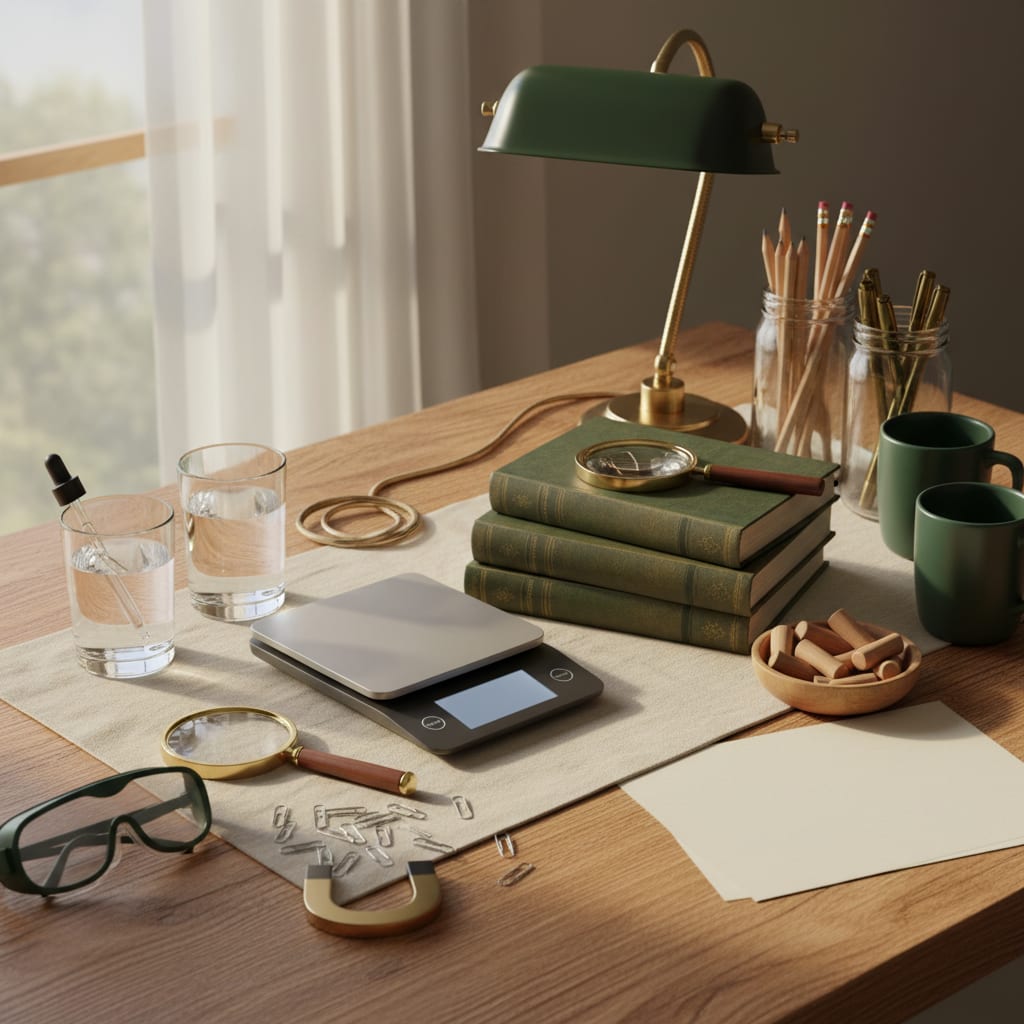
- A hand lens and, later, a basic microscope. The hand lens gets used a hundred times more.
- A digital kitchen scale that reads to a gram. Turns half of physical science into arithmetic you can check.
- Measuring spoons and a graduated cup kept for science, not cooking, so nothing waits on the washing-up.
- Plastic droppers and small clear cups. Small volumes make comparison visible.
- Safety goggles, cheap, one per child. They cost almost nothing and they set the tone.
- A thermometer, ideally two, so temperatures can be compared rather than just read.
- A magnet set, a flashlight, string, tape, balloons, food coloring, vinegar, baking soda, cornstarch.
If you’d rather buy that as a box than assemble it, the Learning Resources Primary Science Lab Activity Set is the standard starter kit — droppers, beakers, goggles and a magnifier aimed at the youngest end of elementary. It’s a convenience purchase rather than a necessity; everything in it has a kitchen-drawer equivalent.
What I’d skip: subscription experiment boxes bought as a curriculum. As a monthly treat they’re delightful. As your science program they teach that science arrives in a box someone else packed, which is close to the opposite of the lesson.
Running an investigation so it counts
The format that turns a kitchen activity into science, in five lines a child can hold in their head:
- Question. “Does salt water freeze slower than plain water?”
- Prediction. Said out loud, before anything is poured, by every person present. Adults included — being wrong in front of your children is excellent teaching.
- The one change. Two identical cups, identical water, identical shelf. One gets salt.
- Observation. Checked on a timer, described in specifics.
- What we think now. Not “the right answer” — what the evidence supports, and what you’d change if you ran it again.
Twenty minutes. Do that once a week for a year and you have a science education that will hold up against a classroom one. The same logic — take the thing you were doing anyway and make the thinking explicit — is what powers everyday math at home, and it’s the reason a supermarket trip can carry real content, as in the grocery store is a classroom.
A word on safety, the one place I’ll be boring: no sealed containers, nothing heated in a closed vessel, no mixing cleaning products, adults handle heat for under-eights, and read the label on anything before it enters an experiment. Goggles from day one.
Where a curriculum earns its money
You don’t need one to do good science at these ages. You may still want one, for two honest reasons: sequence, so you’re not teaching magnets for the third year running, and content depth, because at some point the child asks a question you can’t answer well.
Broadly, three shapes are on the market. Video-led programs — Mystery Science and Generation Genius are the two most homeschoolers land on — supply the lesson and the demonstration, with a low prep burden. Book-based programs such as Elemental Science supply a sequence and a schedule and expect you to teach. Kit-based programs supply the materials, and cost accordingly. Which shape fits you depends less on the science than on how much preparation you can actually sustain in week nine, which is the same question that runs through how to choose homeschool curriculum.
Two hedges. Check what a subscription includes for a homeschool family specifically — several are priced and packaged for classrooms, and terms change. And treat grade labels as suggestions; the sequence in elementary science is far less load-bearing than in math.
Keeping a record without a lab notebook
Portfolio-style evidence is easy if you capture it as you go and impossible if you reconstruct it in June. What we keep: a photo of the setup, one sentence of prediction in the child’s own handwriting, and one sentence of what happened — filed the same day.
Whether you’re required to keep anything at all varies enormously by state and by the option you’re homeschooling under, and it changes — check your state department of education and your state homeschool organization for current requirements rather than relying on a blog, including this one. Where to look them up is set out in homeschool laws: how to find your state’s rules.
FAQ: homeschool science at home
Homeschool science at elementary and middle-school level needs no lab: a kitchen, a hand lens, a scale, droppers and goggles cover it, because the actual curriculum at these ages is observing, predicting, changing one variable and recording the result.
Do you need a microscope to homeschool science?
Not in the early years. A hand lens does far more work, far more often. A basic compound microscope becomes genuinely useful around middle school when cells enter the picture, and a modest one is enough — resolution stops being the limiting factor long before price does.
How often should we do science experiments?
One properly run investigation a week beats five rushed ones. The bottleneck is not activity count; it’s whether predictions were made out loud and results were written down, and both of those take time you have to leave in the lesson.
What about high-school lab science?
That’s where outside provision starts to matter, because transcripts and college admissions may expect documented lab hours. Common routes are a co-op lab class, a community-college course, or a purchased lab kit with a syllabus. Requirements vary by state and by institution — check the specific colleges you have in mind rather than assuming.
Can science be part of everyday life instead of a subject?
Partly, and it should be — cooking, weather and the yard all carry real content. But the “one change at a time” habit rarely appears on its own, so keep a short weekly slot where you deliberately run something.